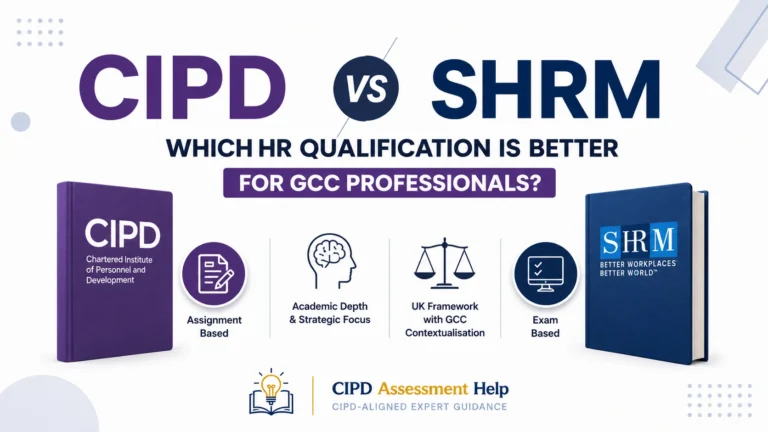
CIPD is gaining popularity rapidly among People Management professionals in Dubai, just as it has in the UK. And with more talent being attracted to work in Dubai, so is the need for competent and qualified People Management. This is one of the reasons why CIPD has become a top choice professional qualification for People Management professionals looking to stand out from the competition. With that being said, attaining CIPD isn’t a walk in the park. It involves extensive reading time and thorough preparation before attempting an assessment. Balancing the implementation of the latest legislation, such as the Federal Decree-Law No. 33 of 2021, and the deep research required for CIPD units, you will likely end up with burnout. That, coupled with work commitments and family, makes achieving CIPD a pipe dream for some. That’s where CIPD assignment writing help in Dubai transitions from convenience to a long-term strategic investment.
Why Dubai-Based CIPD Learners Face a Unique Challenge
CIPD assessments at Level 5 and Level 7 require you to apply HR theory to a real or simulated organisational context. The marking descriptors are explicit: referencing a country or employer by name is not enough. You must demonstrate that the local context genuinely shapes your analysis. For learners based in the UAE, this creates a challenge that UK-based learners never encounter. Most CIPD study materials, tutor guidance, and model answers are written with UK employment law and UK organisational culture as the default. When your assessor reads an answer about employment relationship management, they expect applied analysis — but your workplace operates under Federal Decree-Law No. 33 of 2021 and MOHRE regulations, not the Employment Rights Act 1996. This gap is where UAE-based learners lose marks. The HR knowledge is usually sound. The problem is that the application either defaults to UK law (because that’s what the textbooks assume) or mentions UAE law so superficially that the assessor cannot see how it genuinely informs the people management decision being discussed.
Why Should You Consider My Service for CIPD Assignment Help in Dubai?
While there are a ton of websites that promise CIPD assignment help, not all are reliable, and most use a generic writer instead of an HR-certified professional researcher. Working with me, you are guaranteed to work with an award-winning HR professional researcher backed by years of experience in the People Management realm. Here are a few more reasons to turn to me for CIPD assignment writing help in Dubai:
- MOHRE Compliance — my deep understanding of UAE Labour Law, including the latest Federal Decree-Law No. 33 of 2021, puts me ahead of the competition.
- Cultural Intelligence — CIPD assessors expect practical scenarios applied to HR theories. My deep understanding of the UAE’s multi-national workforce makes the content highly relevant.
- Deep Understanding of CIPD Standards — from word count policy and A.C. requirements to command verbs and referencing, CIPD assessment requirements are unique. Instead of being anxious about results, you can rest assured of passing and plan your timeline with confidence.
- Confidentiality and Trust — any information you share with me is strictly confidential. This website is secured using the latest encryption software.
- Originality — all assignments are delivered with both a Turnitin report and an AI originality report, so you can submit with complete confidence.
Free resource: WhatsApp Moses for a free review of your assignment brief. He’ll identify the command verbs, the UAE-specific evidence you need, and the most common pitfalls GCC learners face — in 15 minutes, at no cost.
The UAE HR Frameworks Moses Integrates Into Your Assignments
Every assignment Moses mentors for a UAE-based learner is built around the employment realities of the Emirates — not retro-fitted with a few local references after drafting a UK-centric answer. The frameworks that appear consistently across Level 3, 5, and 7 assessments include:
- Federal Decree-Law No. 33 of 2021 (UAE Labour Law) — The UAE’s comprehensive employment legislation replaced the previous Federal Law No. 8 of 1980 and introduced significant changes: abolition of unlimited contracts (Article 8), new end-of-service gratuity calculations (Articles 51–53), expanded anti-discrimination provisions (Article 4), non-compete clauses (Articles 10–12), and a standardised 14-calendar-day notice for probationary termination. For CIPD units on employment relationship management (5HR01, 7HR01), these specific articles — not UK legislation — are what your assessor needs to see applied to workplace scenarios.
- Emiratisation and Nafis — The UAE’s nationalisation programme targets 10% Emirati private sector employment by 2026, with a 2% annual increase mandate for companies with 50+ employees. Non-compliance penalties reach AED 72,000 per missing Emirati employee per year. For CIPD units on resourcing, talent management (5HR02, 7HR02), and workforce planning, Emiratisation is the defining policy constraint — equivalent in impact to what Saudisation is in KSA. Moses integrates current Nafis incentive structures (salary top-ups, pension contributions, child allowances) and the specific compliance thresholds relevant to your employer’s sector.
- MOHRE (Ministry of Human Resources and Emiratisation) — MOHRE administers employment permits, Wage Protection System (WPS) compliance, labour disputes, and the classification of establishments. For assignments covering organisational compliance, reward management, and employment law, MOHRE’s regulatory role provides the UAE-specific institutional context that assessors expect. Moses references specific MOHRE Ministerial Resolutions where relevant to the assessment criteria.
- Free Zone Employment Regulations — The UAE has 40+ free zones (DIFC, ADGM, JAFZA, DMCC, etc.), each with its own employment regulations that override — or operate alongside — Federal Decree-Law No. 33. DIFC employees fall under DIFC Employment Law No. 2 of 2019; ADGM employees under the ADGM Employment Regulations 2019. If your organisation operates in a free zone, your CIPD assignment must reference the correct legal framework — not the federal law. This is a common error that Moses specifically checks for.
- Wage Protection System (WPS) — The electronic salary transfer system administered by MOHRE requires all private sector employers to pay salaries through approved banks and exchange houses. WPS compliance, including the requirement to pay within 15 days of the due date, appears in CIPD units covering reward, compliance, and organisational governance. Moses integrates WPS requirements where the marking criteria call for evidence of compliant people practice.
- We the UAE 2031 and National Strategy — The UAE’s national vision document and sector-specific strategies (UAE Centennial 2071, National Innovation Strategy, AI Strategy 2031) are reshaping workforce planning and organisational development across the Emirates. For CIPD units on organisational strategy (5CO01, 7CO02), connecting people management decisions to national economic direction demonstrates the strategic thinking that assessors reward at higher mark bands.
- KHDA and Professional Recognition — The Knowledge and Human Development Authority regulates education and training providers in Dubai. KHDA recognition of CIPD study providers (such as ICS Learn’s Live Online format) is relevant for learners whose employers require locally recognised qualifications. Moses can advise on which study format carries KHDA recognition for your specific employment context.
What CIPD Mentoring with Moses Includes
Moses holds an MSc in Human Resource Management from the University of Birmingham and is CIPD Level 7 qualified — above the qualification level he mentors. Every engagement is direct with Moses. Nothing is outsourced or delegated.
The four-step process
- Free Brief Review (WhatsApp) Send your assignment brief and deadline. Moses reviews the command verbs, learning outcomes, and marking descriptors within 2 hours. He identifies the UAE-specific evidence you will need and flags the most common referral risks for that unit. This review is free and carries no obligation.
- Brief Deconstruction Every command verb is mapped to what the assessor expects. “Analyse” and “evaluate” require different approaches — getting this wrong is the most common reason for lost marks across all CIPD levels. Moses deconstructs the brief against the current marking descriptors, not a generic interpretation.
- Draft and Refine A structured, Harvard-referenced draft is produced, contextualised to your UAE organisation, free zone, or the case study provided in the brief. You review the draft, provide feedback, and Moses revises. Revisions are unlimited — the work continues until you are completely satisfied.
- Final Submission with Turnitin Report The final document is delivered with a Turnitin plagiarism report and an AI originality report. If your assessor refers the work after submission, Moses reviews the feedback, identifies the specific gap, and produces a revised version at no additional cost.
Pricing for Dubai and UAE-Based Learners
All pricing is per individual assignment. There are no retainers, package fees, or hidden costs. For a full breakdown of what CIPD study costs in the UAE — including provider tuition fees, CIPD membership, and registration — see the complete CIPD course cost guide.
| Level | Price (AED) | Price (GBP) | What’s Included |
|---|---|---|---|
| CIPD Level 3 | From 450 AED | From £120 | Assignment structure, HR principles, UAE labour law context, Harvard referencing, unlimited revisions |
| CIPD Level 5 | From 550 AED | From £150 | Organisational performance focus, strategic HR in UAE context, free zone compliance, CIPD Profession Map integration, unlimited revisions |
| CIPD Level 7 | From 800 AED | From £220 | Strategic leadership support, research-level guidance, postgraduate academic writing, examiner-expectation briefing, unlimited revisions |
View full pricing and what’s included →
Which CIPD Units UAE Learners Most Commonly Need Help With
Based on Moses’s experience mentoring 500+ units for GCC professionals, these are the units where Dubai and UAE-based learners most frequently seek support — and where the UAE context is most critical to passing.
Level 5 — Most Requested
5CO01
Organisational Performance and Culture in Practice
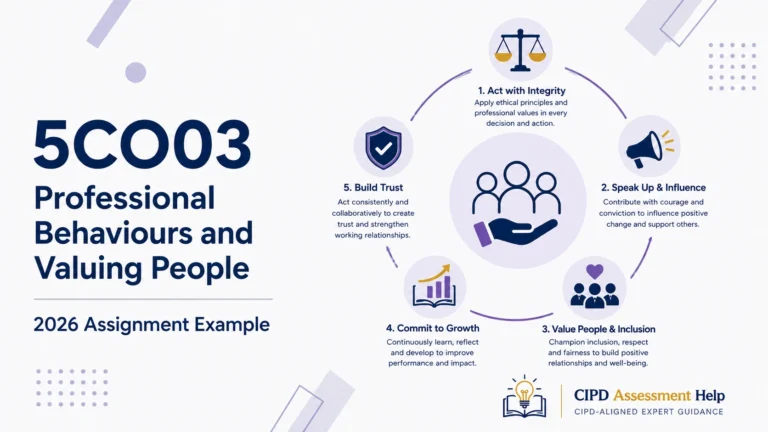
The most-referred Level 5 unit. Requires applied analysis of organisational structure and culture. UAE learners must connect their analysis to how UAE organisations operate — multi-national workforces with 200+ nationalities, flat vs. hierarchical structures across free zones and mainland companies, and the cultural dynamics of managing diverse teams where the majority of employees are expatriates. See the full 5CO01 assignment example →
5HR01
Employment Relationship Management
Requires employment law application. UAE learners must reference Federal Decree-Law No. 33 of 2021, not UK legislation, when discussing contracts, termination, grievance procedures, and worker rights. Free zone learners must cite the correct free zone law (DIFC Employment Law, ADGM Regulations, etc.) — applying federal law to a DIFC employee is a factual error that assessors will penalise. See the 5HR01 assignment example →
5HR02
Talent Management and Workforce Planning
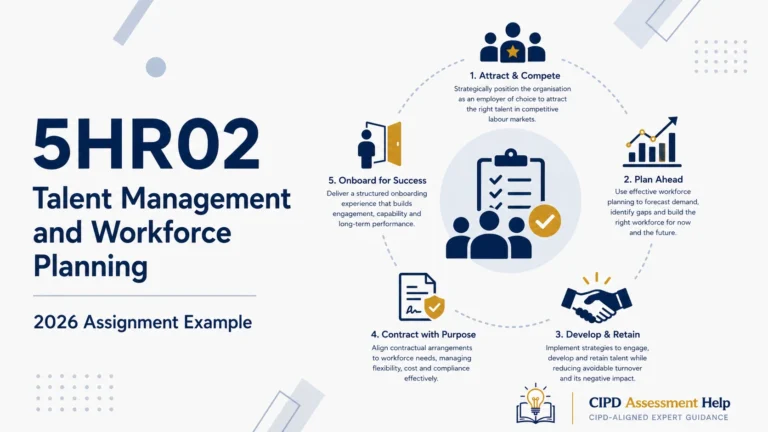
Emiratisation is the defining workforce planning constraint for any UAE employer with 50+ staff. This unit requires discussion of resourcing and talent strategies — doing so without addressing nationalisation targets, Nafis incentives, and the specific challenges of attracting, developing, and retaining Emirati talent alongside an expatriate workforce produces answers that miss the context assessors expect.
5CO02
Requires demonstration of how HR decisions should be informed by data and evidence. UAE learners can draw on MOHRE statistics, UAE National Bureau of Statistics workforce data, Dubai Statistics Centre reports, and Emiratisation compliance dashboards as evidence sources that UK-based learners do not have access to. See the 5CO02 assignment example →
Level 7 — Strategic Units
7CO01
Work and Working Lives in a Changing Landscape
Requires analysis of how macro-economic, social, and technological trends are reshaping work. For UAE learners, this means economic diversification beyond oil, the rise of Dubai as a global talent hub, remote work visa programmes (Dubai Virtual Working Programme), the growth of AI and automation across government services (UAE AI Strategy 2031), and evolving workforce demographics as Emiratisation accelerates.
7CO02
People Management and Development Strategies
Requires strategic-level analysis of how people management supports organisational objectives. UAE learners working in government-linked entities, ADNOC group companies, Emirates Group, or free zone authorities have uniquely compelling strategic contexts — multinational talent pipelines, nationalisation quotas, and rapid organisational scaling — that, when properly articulated, produce high-scoring submissions.
What UAE Employers and Organisations Moses Has Contextualised For
Moses has mentored assignments contextualised to organisations across the UAE economy, including:
- Government and semi-government: Federal Authority for Government Human Resources, Dubai Government HR departments, Abu Dhabi Executive Council entities, and organisations operating under the UAE Government Excellence System
- Energy and industrial: ADNOC group companies, DEWA, ENOC, Masdar, and suppliers operating within Abu Dhabi’s industrial ecosystem
- Aviation, logistics, and tourism: Emirates Group, Etihad Airways, dnata, DP World, Emaar, and Jumeirah Group — sectors where talent management operates at a scale and diversity rarely found outside the UAE
- Financial services (mainland and free zone): UAE banks (FAB, Emirates NBD, ADCB), insurance companies, and DIFC/ADGM-regulated firms where employment law differs from the federal framework
- Free zone organisations: Companies operating under JAFZA, DMCC, Dubai Internet City, Dubai Healthcare City, ADGM, and DIFC — each with distinct employment regulations that must be correctly referenced in CIPD assignments
- Healthcare and education: DHA-regulated hospitals, MOHAP facilities, private healthcare groups, and KHDA-regulated education providers
- Real estate and construction: Major developers and contractors where workforce welfare regulations, WPS compliance, and labour accommodation standards are core HR responsibilities
The specific organisational context is never generic. Moses researches your employer, your sector, your free zone (if applicable), and the regulatory environment your organisation operates in before structuring the assignment.
Conclusion
CIPD assignment writing help in Dubai isn’t about shortcuts — it’s about taking a strategic step towards achieving the “Associate CIPD” or “Chartered Member” status. That’s a mark that gives you leverage for a higher salary and stronger professional credibility. For HR leaders and L&D professionals, working with Moses means a smooth learning journey without compromising your current job performance.
Ready to Start Your CIPD Assignment in United Arab Emirates?
Message Moses directly on WhatsApp for a free brief review. He’ll deconstruct your assignment brief, identify the Saudi-specific evidence you need, and map the command verbs to what the assessor expects — within 2 hours, at no cost.
WhatsApp Moses — Free Brief Review