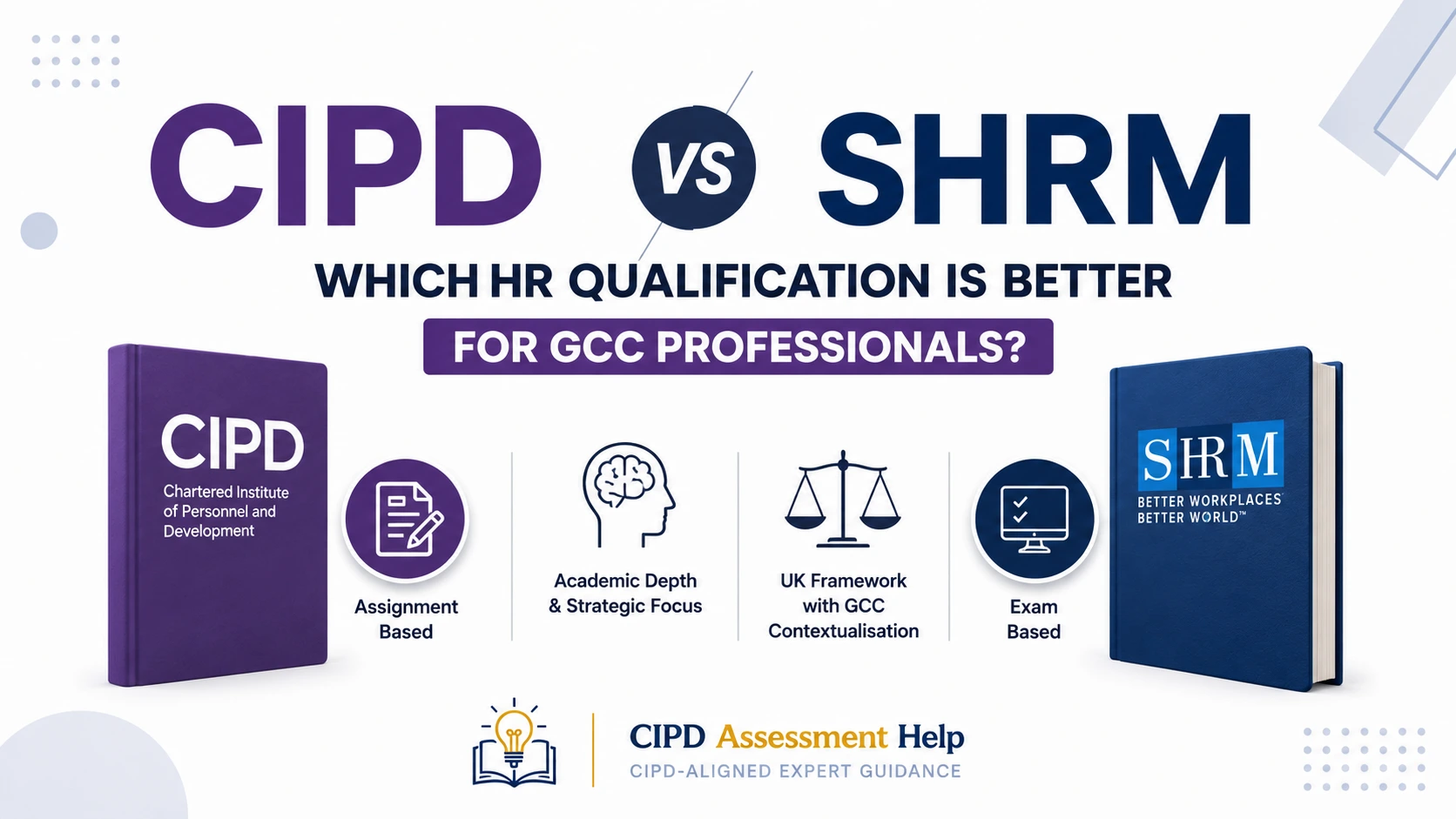
If you work in HR in the GCC, you have almost certainly encountered both acronyms: CIPD (Chartered Institute of Personnel and Development) and SHRM (Society for Human Resource Management). Both are internationally recognised HR qualifications. Both claim to develop professional HR competence. And both are referenced in GCC job descriptions with increasing frequency.
But they are fundamentally different qualifications — different in structure, assessment method, theoretical approach, and the type of professional they produce. Choosing the wrong one costs you time, money, and career momentum. This guide provides an honest comparison to help GCC-based HR professionals make the right choice.
What Each Qualification Is
CIPD (UK-Based)
The CIPD is the UK’s professional body for HR and people development, founded in 1913. It offers qualifications at three levels:
- Level 3 Foundation Certificate — equivalent to A-Level, for HR newcomers
- Level 5 Associate Diploma — equivalent to undergraduate degree, for mid-career HR professionals
- Level 7 Advanced Diploma — equivalent to master’s degree, for senior/strategic HR professionals
CIPD qualifications are assessed through written assignments — typically 3,000–5,000 words per unit, assessed against specific criteria using Harvard referencing and applied to a case study or organisational context. There are no exams. The assessment tests whether you can apply HR theory to real organisational challenges in writing.
Upon completion, you become a member of the CIPD at the relevant grade: Foundation Member (Level 3), Associate Member — Assoc CIPD (Level 5), or Chartered Member — Chartered MCIPD (Level 7).
SHRM (US-Based)
SHRM is the US-based professional HR association, the world’s largest HR membership organisation. It offers two certifications:
- SHRM-CP (Certified Professional) — for HR professionals in operational/implementation roles
- SHRM-SCP (Senior Certified Professional) — for senior HR professionals in strategic/leadership roles
SHRM certifications are assessed through a computer-based exam — 134 multiple-choice questions (including situational judgement items) completed in 4 hours. There are no written assignments. The exam tests knowledge recall and situational decision-making through standardised questions.
SHRM certifications must be renewed every three years through continuing education credits (60 PDCs — Professional Development Credits).
Head-to-Head Comparison
| Feature | CIPD | SHRM |
|---|---|---|
| Origin | United Kingdom (1913) | United States (1948) |
| Assessment method | Written assignments (3,000–5,000 words each) | Computer-based exam (134 questions, 4 hours) |
| Qualification levels | 3 levels (3, 5, 7) | 2 levels (CP, SCP) |
| Highest level equivalent | Master’s degree (Level 7) | Professional certification (no degree equivalence) |
| Assessment focus | Applied analysis, critical thinking, academic writing | Knowledge recall, situational judgement |
| Referencing required | Yes — Harvard referencing throughout | No — exam-based |
| Renewal requirement | Annual CPD and membership fee — qualification is permanent | Every 3 years — 60 PDCs required to maintain certification |
| Legal framework | UK employment law (with contextualisation) | US employment law |
| Study duration | 6–24 months depending on level | 2–4 months preparation for exam |
| GCC recognition | Widely recognised, especially in UK-influenced organisations | Growing recognition, especially in US-influenced organisations |
| Membership body | CIPD — professional body with code of conduct | SHRM — membership association |
| Typical cost (GCC) | SAR 3,000–30,000 depending on level | SAR 5,000–8,000 for exam + preparation |
The Key Differences That Matter
1. Assessment Method: Assignments vs Exam
This is the most significant practical difference.
CIPD assignments require you to construct extended written arguments, apply theory to specific organisational contexts, use Harvard referencing, and demonstrate sustained analytical or critical thinking over 3,000–5,000 words per unit. This develops — and tests — your ability to produce professional reports, strategic analyses, and evidence-based business cases. The skills you develop through CIPD assessment are directly transferable to the professional writing requirements of senior HR roles.
SHRM exams test knowledge recall and situational decision-making through multiple-choice questions and situational judgement items. You must identify the “best” answer from four options — a format that tests breadth of knowledge and decision-making speed but does not develop the extended analytical writing that board-level HR roles require.
The implication for GCC professionals: If your career trajectory points toward HR Director, Head of HR, or board-level advisory roles — where you will need to write strategy papers, business cases, and policy documents — CIPD’s assignment-based assessment develops the skills you will actually use. If you need a credential quickly and are comfortable with exam-based assessment, SHRM is faster to obtain.
2. Theoretical Depth: Academic Rigour vs Practical Application
CIPD (especially at Level 7) is academically rigorous. It requires engagement with peer-reviewed research, theoretical frameworks, and academic debate. You are expected to critically evaluate theories — not just apply them. This develops the intellectual capability to challenge conventional thinking, design evidence-based strategies, and contribute original analysis to organisational decision-making.
SHRM is practically oriented. It tests competency in the SHRM Body of Applied Skills and Knowledge (SHRM BASK), which covers behavioural competencies (leadership, ethical practice, business acumen) and HR knowledge domains (people, organisation, workplace). The focus is on knowing what to do in practical situations — not on the theoretical foundations of why it works.
The implication: CIPD produces deeper thinkers. SHRM produces faster decision-makers. Both are valuable — the question is which capability you need more for your career goals.
3. Legal Framework: UK Law vs US Law
CIPD is built on UK employment law — the Employment Rights Act, Equality Act, Trade Union and Labour Relations Act, etc. However, CIPD explicitly encourages contextualisation: GCC-based learners are expected to apply the employment law of their jurisdiction (Saudi Labour Law, UAE Federal Decree-Law No. 33, Qatar Labour Law, etc.) rather than UK law. The CIPD framework teaches legal principles that are transferable; the specific legislation is context-dependent.
SHRM is built on US employment law — Title VII, FLSA, ADA, FMLA, NLRA, etc. The exam tests US-specific legal provisions. For GCC-based professionals, this means studying legal provisions that do not apply to your workplace. While the principles of employment law are universal, the specific statutes are not.
The implication for GCC professionals: Neither UK nor US employment law directly applies to GCC workplaces. However, CIPD’s assignment format allows you to apply your own jurisdiction’s law — which means your CIPD study is directly relevant to your daily practice. SHRM’s exam format requires you to learn US law for the exam regardless of where you work.
4. Duration and Commitment
CIPD requires sustained commitment over months. Level 3 takes 6–9 months. The Level 5 Associate Diploma takes 12–18 months. Level 7 takes 18–24 months. Each unit requires research, writing, referencing, and revision. This is a significant time investment — but the extended study period develops deep knowledge and applied capability.
SHRM requires intensive preparation over weeks. Most candidates prepare for 2–4 months, using study guides, practice exams, and preparation courses. The exam is a single event — you either pass or you don’t. This is a smaller time investment — but the knowledge development is correspondingly narrower.
5. Renewal and Permanence
CIPD qualifications are permanent. Once you earn Level 5 or Level 7, the qualification does not expire. You maintain CIPD membership through annual membership fees and CPD activities, but the qualification itself is yours for life.
SHRM certifications expire every 3 years. You must earn 60 Professional Development Credits (PDCs) within each 3-year cycle to renew. If you do not renew, you lose the certification and must re-exam. This creates an ongoing obligation — and ongoing cost.
Which Is Better for GCC HR Professionals?
Choose CIPD If:
- You work for a UK-influenced or European-influenced organisation in the GCC
- Your employer or target employer specifies CIPD in job descriptions
- You want a qualification with academic degree equivalence (Level 7 = master’s)
- You prefer assignment-based assessment over exam-based
- You want to develop extended analytical and professional writing skills
- You want a permanent qualification that does not require renewal
- You are targeting HR Director or strategic HR roles where Chartered MCIPD carries weight
- You want to apply your own jurisdiction’s employment law in your studies
Choose SHRM If:
- You work for a US-influenced organisation in the GCC (American multinationals, US-headquartered companies)
- Your employer or target employer specifies SHRM-CP/SCP in job descriptions
- You prefer exam-based assessment and want a credential quickly
- You are comfortable studying US employment law for the exam
- You want a globally portable credential recognised primarily in US-influenced markets
- You are confident in your ability to maintain the 3-year renewal cycle
Consider Both If:
Some senior HR professionals in the GCC hold both CIPD and SHRM certifications. This signals dual competence — strategic depth (CIPD) and practical breadth (SHRM). If your career spans organisations with different cultural orientations (UK/European and US), holding both credentials maximises your market value.
What GCC Employers Actually Ask For
In practice, GCC employer preferences vary by sector and organisational culture:
Government and semi-government entities (Saudi Aramco, ADNOC, Qatar Energy, government ministries) — CIPD is more commonly referenced, particularly at Level 5 and Level 7. These organisations tend to follow UK/European HR frameworks and value the academic rigour of CIPD qualifications.
Financial services (banks, insurance, investment firms) — Both are recognised. CIPD is slightly more common in GCC-headquartered banks; SHRM is more common in US-headquartered firms with GCC operations.
Multinational corporations — Depends on the company’s headquarters. US multinationals tend to recognise SHRM. UK/European multinationals tend to recognise CIPD. Both are accepted by most large multinationals as evidence of HR professional development.
SMEs and local businesses — CIPD is more commonly recognised in GCC SMEs, largely because CIPD has a stronger presence in GCC study centres and a longer history of operation in the region through CIPD Middle East.
Consulting and professional services — Both are valued. The choice often depends on the firm’s client base and practice orientation.
The Bottom Line
For GCC-based HR professionals, CIPD is generally the stronger choice — particularly if you want a qualification with academic depth, degree equivalence, and permanent validity. CIPD’s assignment-based assessment develops the professional writing and critical thinking skills that senior HR roles demand, and its framework explicitly accommodates GCC contextualisation.
SHRM is the better choice if you work in a US-influenced environment, prefer exam-based assessment, or need a credential quickly. Its practical focus and global brand recognition have value — but the 3-year renewal requirement and US-centric legal content are significant considerations for GCC-based professionals.
Need Help with Your CIPD Assignment?
Moses provides GCC-contextualised CIPD mentoring for Level 3, 5, and 7. Free initial brief review — replies within 2 hours.
WhatsApp Moses Now