Calmere House was a 42-person care home run by an owner named Kirsten who knew every employee by name. Then Chaffinch Group acquired it, replaced the flat structure with a hierarchy, and within months the sickness absence rate climbed, staff started leaving, and residents lost the personalised care they had come to expect. That story is the backbone of every answer in your 5CO01 submission, and if it does not appear in all twelve of them, you will be referred.
Twelve Questions, One Scenario, No Exceptions
The unit guide puts it bluntly: “Namechecking the Case study or organisations is not enough to achieve. The Case study must be applied to each answer. If not, the answer will not achieve a passing mark.”
That is not assessor advice. That is a hard rule. Writing “as seen in Calmere House” before returning to generic theory will not get you through. The case study needs to do work inside the argument — Kirsten’s consultative leadership style, Chaffinch’s directive approach, the specific consequences for a care home where relationships between staff and residents are the product.
Command Verbs Are Not Optional
Six different command verbs appear across the twelve questions. Each one demands a different kind of response. Writing an “explain” answer to a question that says “evaluate” costs marks even when the knowledge is sound.
- Evaluate — weigh up advantages and disadvantages, then make a judgement (e.g. Q1: flat vs hierarchical structures)
- Analyse — break down why something happened using specific models and evidence (e.g. Q5: why problems occurred after the takeover)
- Assess — make a supported judgement about significance, impact or effectiveness
- Explain — show how something works and why, with clarity about cause and effect
- Discuss — explore different perspectives, arguments or approaches before reaching a conclusion
- Apply — take a model, theory or framework and map it directly onto the case study scenario
Understanding how each command verb changes the shape of your answer is a skill that runs through the entire Level 5 Associate Diploma. Getting it right in 5CO01 makes every other unit easier.
How the Marking Actually Works
Each question is marked 1 to 4. Score a 1 on any single question and the entire submission is referred, regardless of how strong the other eleven answers are. There is no compensation mechanism.
Mark of 1 vs Mark of 2
The difference comes down to three things: some evidence of reading and research, at least one Harvard-referenced source, and genuine engagement with the case study. Every one of the twelve questions requires a reference.
Mark of 3 and 4
Depth of case study application, quality of sources, and how directly the answer responds to the specific command verb used. A mark of 4 asks for “an excellent level of knowledge,” strong examples, and excellent reference to the case study — though the unit guide notes that strong practical application can compensate for a shorter reference list.
Where Learners Typically Lose Marks
Q1 — Evaluating Organisational Structures
The opening question sets the tone for the assessor. A referral-level answer describes flat and hierarchical structures in general terms. A passing answer evaluates the flat structure specifically in the context of a 42-person care home where the owner’s consultative approach depended on direct access to all staff. It then evaluates Chaffinch’s hierarchical structure, considering what layers of reporting mean for an organisation delivering person-centred care.
Q5 — Using Models to Explain Why Problems Arose
This question separates strong submissions from average ones. The brief expects named theoretical models applied to specific events in the case study. Naming Handy’s cultural typology or Rock’s SCARF model is not enough. You need to map specific behaviours — the loss of autonomy, the breakdown of trust, the rising absence — onto the stages or dimensions of the model, with a referenced source.
Q8 — Applying a Change Model to Employee Experience
A referral-level answer summarises the Kübler-Ross curve and notes employees were upset. A passing answer maps the shock at announcement, the growing hopelessness, and the rising sickness absence onto named stages of the model.
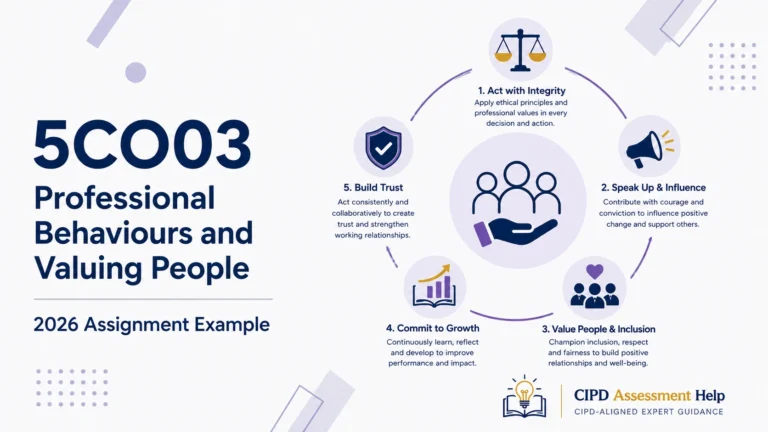
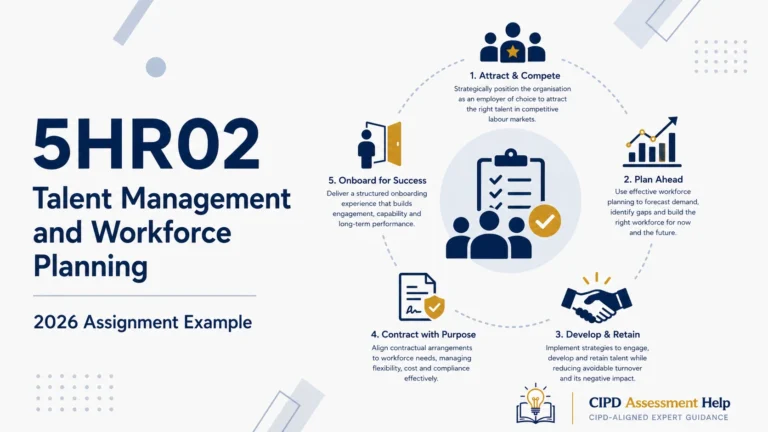
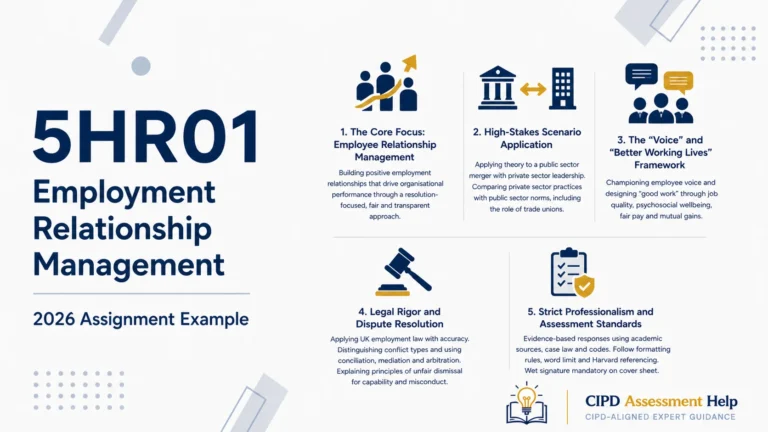
For learners studying our 5HR01 assignment example, the employee voice and conflict concepts in that unit connect directly to how Calmere House staff responded to the changes here. Learners working on 5CO03 will also find overlap — the professional behaviours and ethical practice assessed there underpin how people professionals should respond to the kind of organisational change described in this case study.
Before You Start Writing
Read the marking descriptors in the unit guide and check your planned approach against what a mark of 3 actually requires. Not what you assume it requires — what the assessor guidance says.
- Case study check — does every answer apply the Calmere House/Chaffinch scenario, not just mention it?
- Command verb check — does each answer match the verb used (evaluate, analyse, assess, explain, discuss, apply)?
- Reference check — does every answer include at least one Harvard-referenced source?
- Word count check — is the total within 4,095–5,005, with sensible allocation across questions?
For a detailed breakdown of all twelve questions and what good answers look like, the 5CO01 unit guide covers the risks in this brief. Moses provides expert mentoring on 5CO01 and all Level 3 and Level 5 units — a free brief review is available, with a response within two hours via WhatsApp.
5CO01 Assignment Example 2026
AC 1.1
Flat Non Hierarchical Structure
A flat, non-hierarchical structure has few or no middle managers between subordinates and top management (Schooley, 2024). It promotes free flow of information, teamwork, and quick decision making because it grants employees increased autonomy and responsibility. This structure was effective at Calmere House under Kirsten’s leadership, particularly due to its small workforce. The intimate working atmosphere allowed employees to disseminate ideas, participate in decision-making, and experience a solid personal relationship with the leadership. Kirsten encouraged free communication and embraced input of employees, which built trust and a sense of belonging.
This structure led to motivated employees, engaged employees and a committed workforce to providing high quality and person centred care. This design helped to provide the feel of a traditional family setting where employees always felt that their contribution is significant and has a direct impact on the wellbeing of residents. Nevertheless, there were also other weaknesses in this structure. Decision making depended on one person so much and thus the absence of Kirsten may result in not making any decision or losing direction. Lack of processes and lack of clear allocation of roles might also lead to low accountability and inconsistency. Although this structure may be useful in a smaller and relationship-based environment, it is more challenging to manage as the organisation increases in size and complexity.
Hierarchical Bureaucratic Structure
A hierarchical bureaucratic system is founded on distinct levels of authority, official reporting lines and established policies and practices (Perera, 2025). This is a way of ensuring consistency, control, and accountability that are fundamental in large organisations. This design in the Chaffinch Group case allowed consistent policies, roles, and practices to be enforced across several care homes to serve wider strategic and regulatory targets. It also enhanced accountability and consistency when it came to processes across different locations.
However, its implementation at Calmere House created challenges. Employees felt disconnected and undervalued due to the change in open communication and shared decision making. The more authoritative management approach minimised the chances of teamwork and innovation. Decisions became centralised and responsiveness was slow and this was quite detrimental to the staff morale. Though the hierarchical model entails control and consistency within large organisations, it is not applicable in settings that require close relationships, flexible nature, and employee participation.
AC 1.2
Structured and Evidence-Based Strategy Formation
A rational approach to strategy formulation is a logical and systematic approach to decision making that embodies evidence based decision making rather than assumption-based approaches. It entails evaluating the prevailing conditions, establishing feasible goals, brainstorming and reviewing available alternatives and choosing the most suitable course of action (Athuraliya, 2024). This will be useful in making sure that organisational strategies are based on reliable data. For Chaffinch Group, adopting this strategy would be used to overcome the major issues of workers turning negative towards increasing resident satisfaction and work turnover, as well as aligning future strategies with organisational aims and service expectations.
Identifying Service Gaps and Key Issues
One of the significant areas in need of an improvement is the drop in the quality of resident experience and personalisation of care. Under previous leadership, the residents were addressed as personalities and were allowed to make their living environments personal to them, which increased comfort and a sense of belonging. This practice was altered after the acquisition, where rooms were no longer personalised and became standardised. The change decreased the emotional attachment residents felt towards their environment, which adversely impacted the levels of satisfaction. The first step in the rational process is to identify this issue because it helps to ensure that strategies aim at the most critical service gaps that can affect both the residents and the overall organisational performance.
Environmental Analysis and Objective Setting
A rational approach also involves a detailed analysis of the external factors that can affect the performance of an organisation. The PESTLE Analysis is a tool in which the political, economic, social, technological, legal, and environmental factors of any business can be evaluated (David, 2025). For Chaffinch Group, this can be in the form of heightened regulatory requirements, higher operational expenses, and heightened demand for person-centred care. The knowledge of these aspects assists the organisation in reacting positively to the external forces. As a result of this analysis, clear and measurable objectives can be established, including enhancing resident satisfaction rates to a greater extent in a specified period or decreasing staff turnover. These objectives offer a sense of direction, accountability, and coherence of all activities to the mission of the organisation, which is to offer high-quality and compassionate care.
Developing, Implementing, and Reviewing Solutions
Once objectives are defined, the organisation can generate and assess potential solutions. Some of the options could be reintroducing resident choice in room design, greater involvement of staff in the care planning process, and better communication of management with employees. All the options would be evaluated based on cost, feasibility and long term effect to have a balance between financial performance and quality of care. After the choice of strategies, it is necessary to implement them effectively. The top management should explicitly articulate priorities, which are implemented by managers and frontline workers. At Calmere house, there will be continuous improvement by doing constant monitoring through the feedback given by the residents and employees that will ensure the strategies are always responsive to the evolving customer needs.
Continue Reading the Full 5CO01 Assignment
- All ACs complete & marked
- Editable Word document
- Harvard referencing throughout
- UK & GCC workplace context
- Marking descriptor alignment
- Updated for 2026 assessments