5CO03 is the unit that asks you to turn the lens on yourself. Unlike our 5CO01 assignment example, which analyses organisational performance through a case study, or our 5HR01 assignment example, which applies employment law to workplace scenarios, this unit requires you to critically examine your own professional behaviours, ethical practice, and approach to valuing people.
The referral is rarely caused by weak subject knowledge. It is caused by superficial reflection — describing what you do without examining why, presenting strengths without acknowledging development needs, and treating ethical practice as a box-ticking exercise. If your assignment reads like a competency self-assessment, it will not pass.
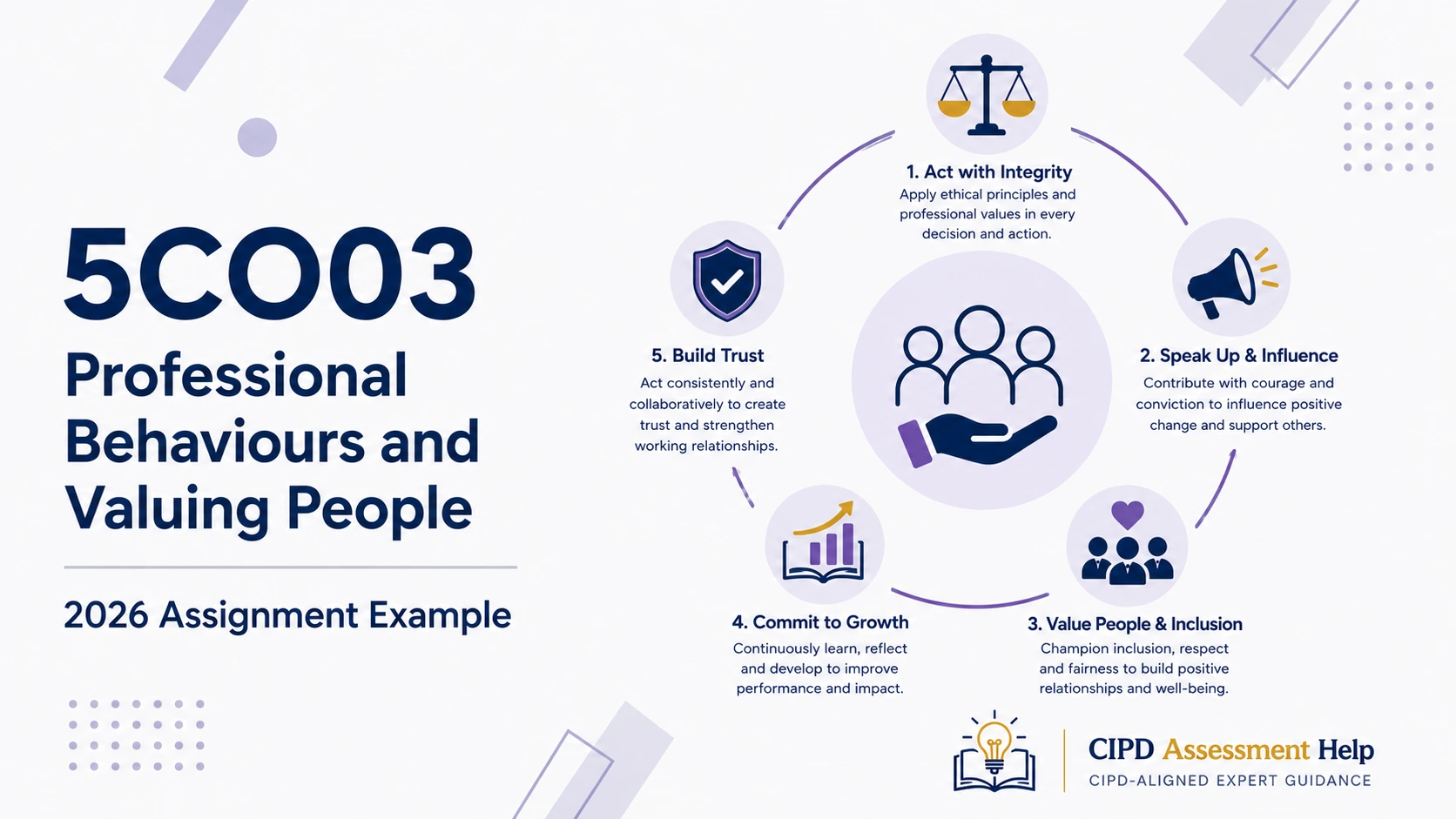
What 5CO03 Is Testing
The unit covers three interconnected areas:
Professional Behaviours
Not a list of behaviours you exhibit — an applied analysis of how professional behaviours translate into effective people practice. The CIPD Profession Map identifies core behaviours (ethical practice, professional courage, valuing people, working inclusively) and specialist behaviours (evidence-based practice, commercial drive, passion for learning). You must evaluate your own practice against them honestly, not self-servingly.
Ethical Practice
The CIPD Code of Professional Conduct sets out expected ethical standards. At Level 5, you must go beyond knowing what the Code says and apply ethical reasoning to real workplace dilemmas — balancing employee welfare against commercial pressure, maintaining confidentiality when information could help a colleague, challenging a manager when the power dynamic discourages it.
Valuing People
Inclusive practice, dignity at work, and creating environments where diverse individuals contribute fully. For GCC-based learners, this carries particular weight — multi-national workforces spanning dozens of nationalities, significant cultural differences in workplace expectations, and structural inequalities between national and expatriate employees.
Assessment Structure
- Task 1 — professional behaviours, ethics, communication and inclusion
- Task 2 — self-reflection and continuing professional development planning
- Both tasks assessed independently — weak performance in either affects the final outcome
What the Marking Descriptors Actually Say
As with all Level 5 units, each assessment criterion is marked 1 to 4. A mark of 2 is the minimum pass. A mark of 1 on any single criterion refers the entire submission.
Low Pass vs Referral
The difference comes down to genuine engagement versus surface treatment. A mark of 1 describes professional behaviours in general terms. A mark of 2 connects them to your own practice with at least one referenced source.
Reaching a High Pass
Depth of reflection and quality of application. A mark of 3 demonstrates genuine critical reflection — acknowledging strengths and weaknesses with specific examples, using models to structure analysis, and producing a specific, actionable CPD plan. A mark of 4 adds exceptional depth, strong wider reading and particularly well-expressed arguments.
What a Good 5CO03 Assignment Example Looks Like
AC 1.1 — Role of a People Professional
- Referral-level: defines what a people professional is and lists Profession Map behaviours
- Pass-level: appraises the role — evaluating what value a people professional adds and what distinguishes professional HR from informal people management
- Strong answer: evaluates the tension between “business partner” and “people champion” — a tension Caldwell (2003) identified as central to HR professional identity — and assesses how it plays out in your own context
AC 1.2 — Personal Values and Ethics
- Weak answer: lists personal values (integrity, fairness, respect) without connecting them to practice
- Strong answer: identifies specific situations where values were tested — commercial pressure conflicting with fair treatment, or cultural norms conflicting with the CIPD Code of Professional Conduct
- GCC learners: navigating the tension between inclusive practice and organisational practices that treat national and expatriate employees differently by design
AC 2.1 — Inclusive Working
- Weak answer: describes collaboration in general terms
- Strong answer: identifies specific inclusive strategies — adapting communication for multi-lingual workforces, ensuring participation where cultural hierarchy norms may discourage speaking up, designing consultation processes that account for different cultural expectations
Where Superficial Reflection Costs Marks
- Giving generic definitions without applying them to the scenario
- Confusing description with evaluation or appraisal
- Failing to support arguments with evidence or references
- Writing reflective answers without genuine self-analysis
- Ignoring the impact of behaviours on organisational outcomes
- Using weak examples that do not demonstrate professional judgement
- Missing Harvard referencing throughout the assignment
The GCC Context for 5CO03
Workforce Diversity at Scale
UAE organisations routinely employ workers from 50+ nationalities. Saudi organisations are managing workforce transition as nationalisation brings citizens into roles previously held by expatriates. The “valuing people” criterion is not abstract in the GCC — it is a daily operational reality requiring specific strategies for cross-cultural communication, culturally sensitive management, and equitable treatment across radically different employment terms.
Structural Inequality
The GCC employment system creates a dual workforce: nationals with government-supported employment and nationalisation protection; expatriates with sponsor-dependent employment and limited safety net. For a people professional committed to valuing all people, this raises genuine ethical questions — how do you advocate for inclusive practice when the system itself differentiates? A strong 5CO03 answer engages with this tension honestly.
Wellbeing in Extreme Environments
Managing heat stress for outdoor workers, supporting psychological wellbeing of workers living away from families, and addressing mental health challenges associated with sponsor-dependent employment and contract renewal uncertainty. These are the lived experience of millions of workers in the region and directly relevant to the wellbeing criteria.
If You Are Working on 5CO03 Now
Conduct an honest self-assessment against the CIPD Profession Map behaviours before writing. Not the version where every behaviour is “developing well” — the version where you identify two or three areas where your practice genuinely falls short, with specific examples.
If you want your brief reviewed or your draft assessed against the marking criteria, Moses provides expert mentoring on 5CO03 and all Level 3 and Level 5 units. A free brief review is available — Moses responds within 2 hours.
5CO03 Assignment Example 2026
AC 1.1
Being a People Professional
The role of a people professional is to act as the link between the organisation and people. This role is about meeting business goals and creating an environment where people want to work, are engaged and are treated fairly (CIPD, 2024). As such, the role requires both business and soft skills such as empathy, integrity and communication skills. The role of a people professional is not only to support the management but also to advocate for the workforce and to ensure ethical standards in the organisation.
In my view, it is a challenging but rewarding role. It requires objective decision making, adaptability to the ever changing world and continuous learning. This role demands being able to juggle multiple issues and to build and maintain relationships.
Key Aspects of the Role
The effectiveness of a people professional is defined by their behaviours, knowledge and ways of working. Behaviours such as integrity, openness and consistency are critical to ensure respectful and fair treatment of employees. In terms of practices, partnering, problem solving and evidence-based practice are vital.
There is also a need for HR knowledge, including employment law and practice, organisational development and learning and development. The CIPD Profession Map highlights the capabilities of insight, strategy and organisational capability building (CIPD, 2023). These underpin decision making through the application of situational knowledge, data and the development of people and teams.
Contributions as an HR Adviser at Nexxobyte
Some of the responsibility of a people professional is to ensure legal and ethical standards are met. This includes creating fair and transparent processes which allow for consistent decision making across the organisation (Page, 2024). For Nexxobyte, this could be achieved by having HR processes in place for recruitment, induction, performance management and development. This will reduce inconsistencies, address employee concerns and reduce turnover.
An important aspect of the HR profession is being an advocate for employees. This includes managing grievances, health and wellbeing and valuing employees (Verlinden, 2020). At Nexxobyte, where non-standardised management practices have resulted in low satisfaction, I would implement consistent grievance procedures, survey employees and talk to managers to ensure consistency and fairness. This would rebuild trust and improve the culture to be more positive and supportive.
AC 1.2
Integrity
Integrity involves ethical behaviour and being consistent in doing the right thing, even when this is difficult. It is about having and living by moral principles, rather than being guided by self-interest or pressures from others (Machell, 2025).
Upon joining Nexxobyte, my integrity would be displayed through challenging unethical practices like discrimination in opportunities for learning and development or inconsistent managerial actions. For example, if specific employees are favoured for training without reason, I will discuss this with the team leader and ensure that clear objective criteria are applied.
Integrity would also be evident in my approach to implementing policies and procedures, ensuring they are applied fairly and consistently. This includes preserving confidentiality when discussing sensitive issues about employees and providing clear communication about processes and expectations. Integrity helps to build trust and credibility among employees and leaders, and enhances the effectiveness of people practices.
Fairness
Fairness is about treating people in a fair and equitable manner, and ensuring that decisions are objective, fair and transparent. It involves consistency in the application of policies and practices, and ensuring that people in the same situation are treated the same (Ndugbu, 2023).
For Nexxobyte, fairness would be crucial in resolving differences in flexible working and development opportunities across teams. For instance, policies for flexible working arrangements and access to training would ensure that all employees are given the same access regardless of who their manager is.
Fairness would also inform the design of people processes like recruitment, performance management and career progression by ensuring that they are objective and free from bias. Training managers to avoid bias in decision making would also help embed fairness. This supports the creation of a work culture in which employees are treated with dignity, respect and trust.
Importance of Consistent Application
Organisational integrity and legitimacy are strengthened through consistent fairness and integrity. Failure to apply these consistently may lead to dissatisfaction, complaints and employee turnover.
At Nexxobyte, this would promote transparency and improve confidence in organisational processes. This would boost morale, reduce conflict and support a more positive culture. By incorporating integrity and fairness into organisational decision making, ethical practice and organisational success are encouraged.
Continue Reading the Full 5CO03 Assignment
- All ACs complete & marked
- Editable Word document
- Harvard referencing throughout
- UK & GCC workplace context
- Marking descriptor alignment
- Updated for 2026 assessments