Two tasks. Two separate word counts. One requires Harvard-referenced academic argument. The other requires calculations, charts, and data interpretation. Most Level 5 learners can handle one of those well. Handling both to the standard the 5CO02 marking descriptors require is where submissions come unstuck.
Technivara and Why the Context Is Not Negotiable
The 2025/2026 brief (CIPD_5CO02_25_01) is built around Technivara, a manufacturing company with a founder who resists change and a people practice function that still relies on paper-based systems. You are the People Practice Advisor, asked by the People Practice Manager to build the case for evidence-based decision-making.
That framing shapes every answer. You are not writing a neutral essay — you are writing to persuade a sceptical leadership team. Answers that read like textbook summaries without connecting to Technivara’s specific situation will not pass.
Task 2 Is Where Marks Disappear
Q8 — Calculations
Q8 asks you to convert turnover and recruitment data into percentages. The unit guide specifies: “Percentages should be calculated based on the total number of employees in each department, not the total employees in the organisation.” Getting that wrong means your charts in Q9 are also wrong, and inaccurate data is an automatic referral on AC 2.1.
Q9 — Diagrams
Q9 requires a minimum of three different diagrammatical forms. Three bar charts do not meet that requirement — you need three distinct types (bar chart, pie chart, line graph, for instance). Each chart must include:
- Legend — identifying what each data series represents
- Labelled axes — clear titles on both x and y axes
- Data labels — values shown on or near the data points
Charts that look clean but lack these elements will score lower than expected.
Q10 — Qualitative Analysis
You are given evaluation feedback from 42 employees after an L&D activity and asked to identify patterns, themes, or trends, then make at least two recommendations. Those recommendations must address benefits, risks, and financial implications, and must be supported with Harvard references. This is the only question in Task 2 that requires referencing — leaving it out drops you to a 1.
If you found the data analysis in 3CO02 manageable, the jump here is not in the maths — it is in the depth of analysis expected. Level 5 asks you to move from describing data to making evidence-based recommendations with financial awareness.
Five Command Verbs, Five Different Responses
Treating all seven Task 1 questions as “explain this topic” is one of the most common mistakes. Each verb demands a different analytical depth:
- Evaluate (Q1, Q2) — make a qualitative judgement about strengths and limitations
- Assess (Q5) — offer a reasoned judgement on two ethical perspectives, not just describe them
- Appraise (Q6) — estimate the worth of financial and non-financial measures, grounded in Technivara’s context
- Explain — show how something works and why, with structured clarity
- Discuss — explore different angles before reaching a conclusion
For broader context on how Level 5 units handle command verbs and application requirements, the 5CO01 assignment example uses the same logic — different verbs demand different analytical depths even when the subject matter overlaps.
What Separates a Pass From a Referral on Q5
Q5 asks you to assess two different ethical perspectives and explain how they could inform moral decision-making at Technivara. The indicative content lists utilitarianism, deontology, communitarianism, and altruism.
- Weak answer: describes utilitarianism and adds a vague comment about HR decisions
- Strong answer: identifies a specific decision Technivara faces — automating parts of the HR function, handling underperformance in a paternalistic culture — and shows how two ethical lenses would produce different conclusions
The contrast between the perspectives is where “assess” lives. Without that contrast, anchored in the case study, the AC is not met.
Referencing Changes Everything at Level 5
At Level 3, a well-applied answer with no bibliography can still pass. At Level 5, that approach will not work. The marking descriptor for a Low Pass requires “evidence of some wider reading” and at least one in-text citation where required.
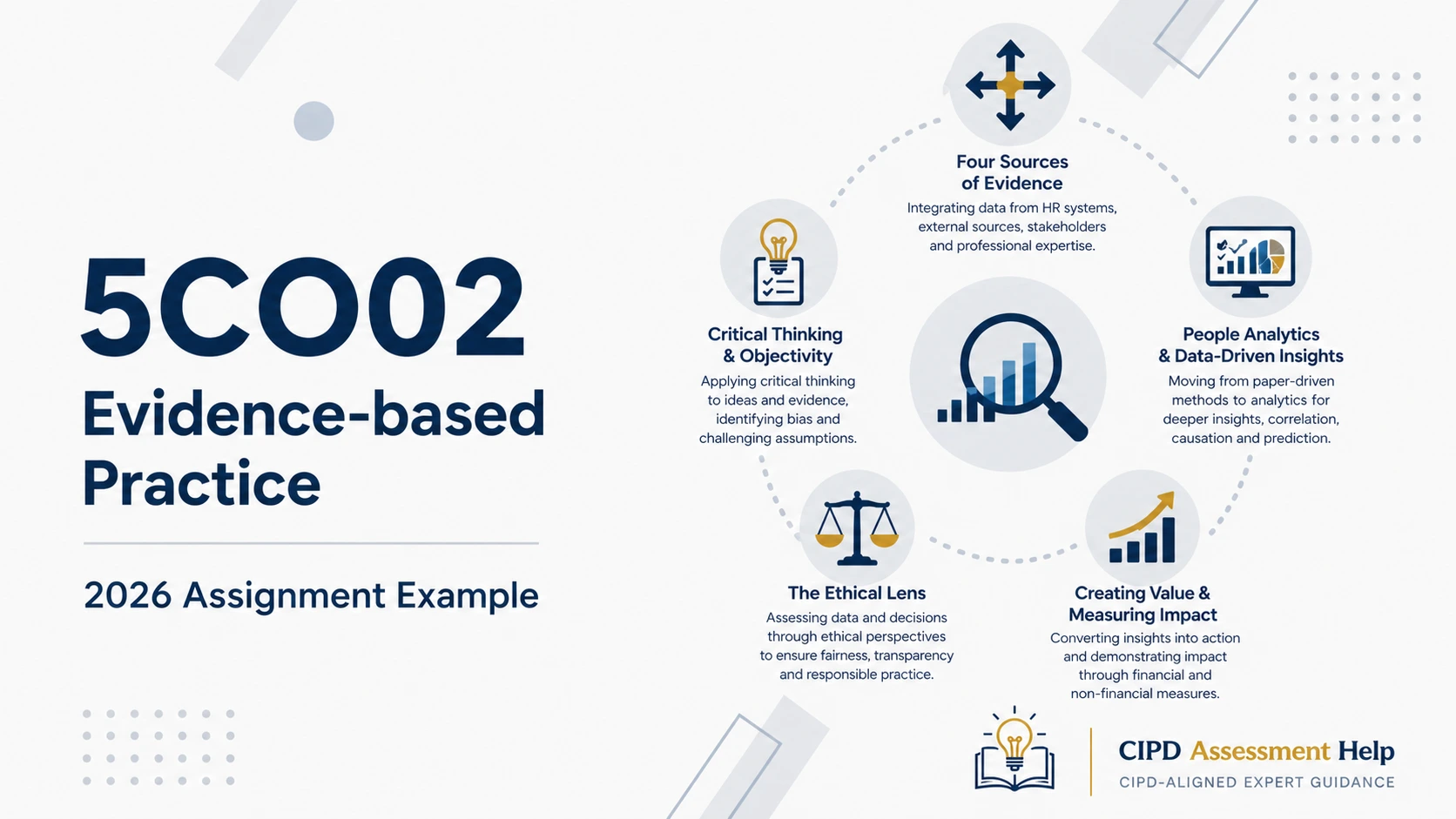
Q1 asks you to evaluate evidence-based practice. The guidance states answers must include “appropriate theoretical strategies and models.” A response that explains EBP without referencing established frameworks will sit at a 1 or 2. A response drawing on CIPD research, naming decision-making models, and connecting them to Technivara’s paper-driven culture will score higher.
Task 1 and Task 2 Checklist
- Task 1 word count — confirm total sits within the permitted range for 2,900 words
- Task 2 word count — confirm total sits within the permitted range for 1,000 words (separate limit)
- Command verbs — check each Task 1 answer matches the verb used (evaluate ≠ explain ≠ assess)
- Q8 calculations — percentages based on departmental totals, not organisation-wide totals
- Q9 diagrams — three different chart types, each with legend, labelled axes, and data labels
- Q10 references — the only Task 2 question requiring Harvard referencing. Do not skip it
The 5CO02 unit guide breaks down every AC across both tasks and explains what the marking descriptors actually require. If you want feedback before submission, Moses is available on WhatsApp — draft reviews typically come back within two hours.
5CO02 Assignment Example 2026
AC 1.1
Evaluating the Concept of Evidence Based Practice (EBP)
Evidence Based Practice (EBP) is a model of decision making which draws on the expertise of the practitioner, information from the organisation, information from stakeholders and external information to justify decisions (The Oxford Review, 2023). EBP is not about relying on opinion and judgement to make decisions, but it is about engaging in critical thinking and informing decisions with evidence. This is particularly important in contemporary organisations that need to take into account multiple viewpoints. Importantly, EBP doesn’t neglect practice; it incorporates evidence and judgement in a way which results in practical decisions.
Models of Decision Making
To evaluate EBP in an effective manner, it is useful to examine traditional models of decision making. The rational decision making model assumes the decision maker has full information, adequate time and will rationally process all alternatives (Houda, 2024). at Technivara, this can involve a step-by-step approach which can help with the consistency and transparency of human resource management. However, this model is sometimes impractical. The reality in most organisations is that they are operating in a rapidly changing environment with relatively little time and limited information.
On the other hand, the model of bounded rationality suggests time, information and cognition are limited (Carrier, 2019). This model is more aligned to EBP, by proposing the use of evidence within these constraints. However, this can lead to satisficing, in which a good enough decision is made, rather than the best decision. EBP helps avoid this by advocating the use of a range of evidence, which helps improve decision making, even when it’s less than perfect.
At Technivara, embracing EBP could positively impact the shift from paper-based to data driven decision making. Without evidence, decision making may be inconsistent. EBP enables the People Practice team to make explicit, objective and strategic decisions as the company plans to grow.
Application in Learning and Development Programmes
EBP can improve the effectiveness of Learning and Development. This involves reviewing internal data (such as employee performance and feedback) and scientific literature for evidence on best-practices for training (Briner and Khan, 2019). This is important for Technivara as it adapts to changing trends in the electronics, medical and automotive industries. The approach is based on research rather than assumption which means that training approaches can be selected to develop skills and performance. This guarantees training interventions are valuable, relevant and connected to organisational strategy thus improving return on investment (ROI) in training.
Application in Reward and Pay Decision Systems
EBP also optimises the reward and pay decisions to ensure they are fair, competitive and justified. This involves assessing the job market rate, performance and what the organisation can afford. EBP at Technivara, where pay decisions have been made subjectively, would ensure greater objectivity. The organisation can use evidence like retention, performance and market pay rates to create an equitable reward system. This avoids the risk of unfair pay practices, and motivates and retains employees as the company expands.
AC 1.2
SWOT Analysis as an Organisational Diagnostic Tool
SWOT analysis is a popular tool to examine the strengths, weaknesses, opportunities and threats of an organisation. This gives an overview of the influence of both the internal and external environment on organisational performance (Peterdy, 2024). Therefore, for Technivara, operating in a dynamic electronics sector, SWOT analysis can help identify internal challenges such as traditional human resource management, a general lack of using analytics and more traditional leadership approaches. It can also identify external challenges like technological developments and increasing customer expectations.
SWOT analysis is simple to apply and flexible. It can capture various opinions from inside the organisation and help to understand organisational performance and position. But it’s not without its shortcomings. The analysis can be subjective (and therefore potentially biased) and it doesn’t necessarily identify actions or solutions. However, SWOT can be used to highlight potential problems to be tackled and to inform strategy at Technivara.
Structured Interviews as an Analysis Method
Structured interviews are a more detailed form of organisational diagnosis, using a predetermined set of questions to employees. It offers a more uniform and comparable approach to data collection and analysis, and is helpful to identify issues common to employees (Wingate and Bourdage, 2024). This could be useful for Technivara to better understand issues such as perceived inequities in training, problems with paper based processes and attitudes towards current decision making processes.
Structured interviews provide rich and clear information. They allow organisations to get feedback from employees and understand their needs. However, this can be time consuming and is potentially limited by an employee’s reluctance to share information, particularly if trust is not established. But the information gained is likely to be valuable, making structured interviews a useful diagnostic tool.
In summary, SWOT provides a broad picture of an organisations’ strengths and weaknesses, but structured interviews can provide more detailed insights. In the case of Technivara, with the need to understand specific issues in the organisation such as out of date systems and people issues, structured interviews are likely to be more valuable. It helps to understand the reasons and allows an evidence led approach to people management.
Continue Reading the Full 5CO02 Assignment
- All ACs complete & marked
- Editable Word document
- Harvard referencing throughout
- UK & GCC workplace context
- Marking descriptor alignment
- Updated for 2026 assessments