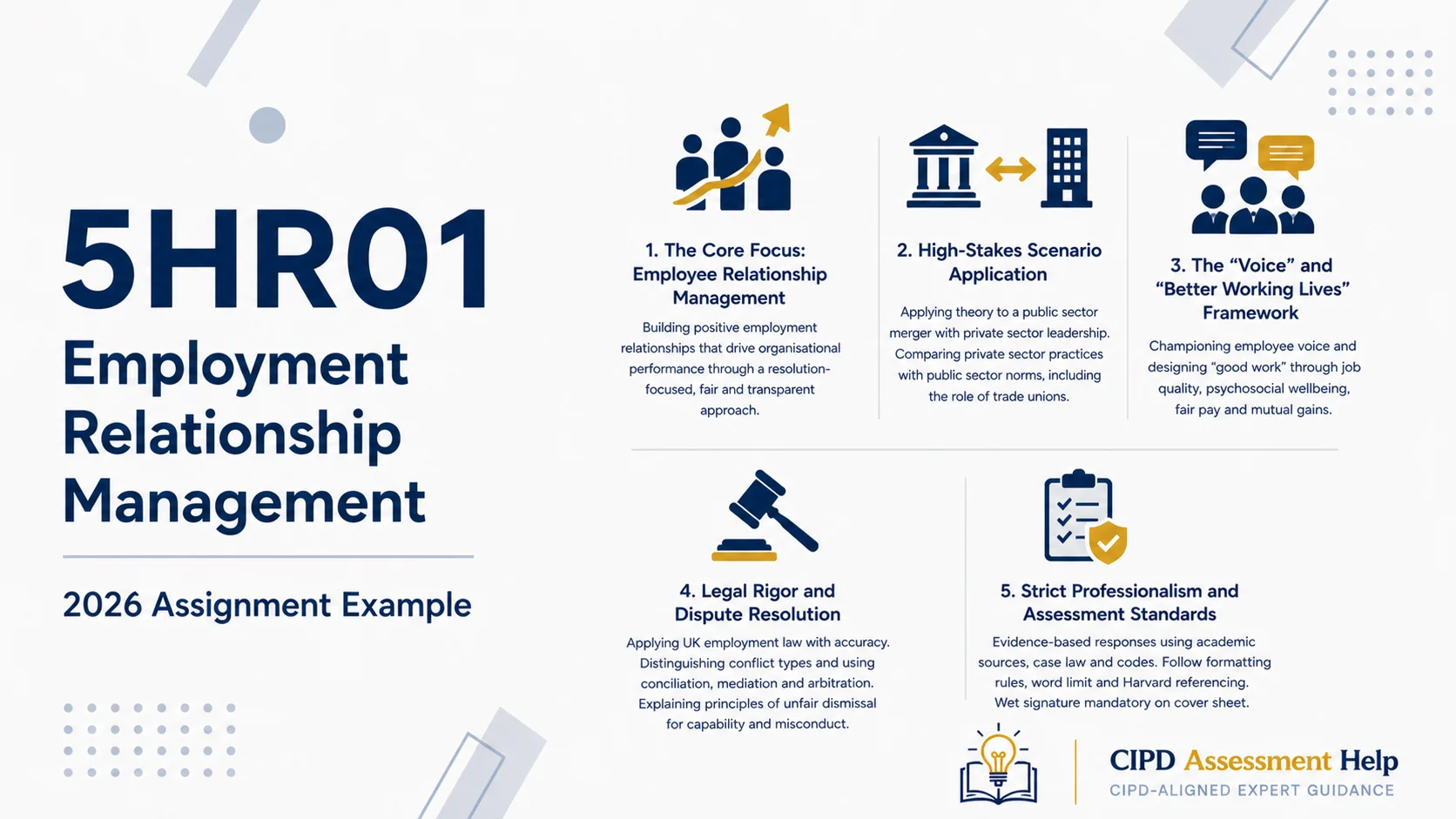
A public sector organisation has just merged with another. The incoming leadership team comes from the private sector and has limited awareness of how employee relations work when unions have a seat at the table, grievances follow strict procedural timelines, and dismissal without due process ends in a tribunal. Your job in 5HR01 is to write a 3,900-word briefing paper that explains all of this to managers who have never operated in that environment.
That audience is the entire assessment. If your paper reads like an academic essay about employment relations theory, you have written the wrong document.
The Scenario Runs Through Every Question
The brief positions you as an HR practitioner in the newly merged organisation. The ten questions cover employee involvement, union and non-union representation, employee voice, better working lives, organisational conflict, emerging trends in industrial sanctions, third-party dispute resolution, unfair dismissal, grievance causes, and grievance handling.
Each topic must be addressed in the context of a public sector merger where the incoming managers have a private sector mindset. That reframing needs to appear throughout — not just a one-paragraph setup at the start. When you write about disciplinary matters, consider how they unfold in a heavily unionised environment. When you explain conciliation, mediation, and arbitration, explain when each is most suitable for an organisation where collective representation is embedded, not optional.
The word count is approximately 3,900 words across ten questions — roughly 390 words each. Harvard referencing is required, and references to specific statutes, case law, and codes of practice are expected throughout. The format must be a professional briefing paper — use AC numbers as headings, not rewritten question titles. A score of 1 on any single question refers the entire submission.
Before submitting, check the front cover sheet — a typed signature is not acceptable. It must be handwritten, scanned, photographed, or a legitimate e-signature. Submissions have been rejected before reaching a marker for this reason alone.
The Questions That Separate Passes From Referrals
Q1 — Employee Involvement vs Employee Participation
AC 1.1 asks you to differentiate involvement from participation. To a layperson they sound interchangeable. For an HR professional, they represent fundamentally different approaches to power:
- Involvement — management-led. The employer invites input through team meetings, suggestion boxes, or feedback sessions, but retains the final decision
- Participation — genuine sharing of power. Collective bargaining, joint consultative committees, co-determination on terms and conditions
In the public sector, participation mechanisms are more deeply embedded than in most private organisations. Your incoming managers need to understand that difference immediately, because the way they handled employee input before will not work the same way here.
This concept of voice and participation connects to how organisational culture shapes employee experience in 5CO01. The structural decisions made at Calmere House produced similar tensions — employees who lost their voice became disengaged. The same dynamic is at risk in your merger scenario.
AC 1.3 — The Hardest Question in the Brief
Evaluating the relationship between employee voice and organisational performance is where most learners either break through or fall short.
- Weak answer: lists the benefits of employee voice
- Passing answer: asks harder questions — does voice actually improve measurable performance? How would you measure that link?
- Strong answer: provides a balanced argument — reference high-performance work practices research that supports the connection, then introduce the limitations
Most of the supporting research comes from the private sector. Question whether it applies to a public sector organisation where performance is measured in service quality and societal benefit, not financial returns. Note that poorly implemented voice mechanisms can be demoralising — employees feel consulted but not heard. Point out that widespread consultation can slow decision-making during time-critical changes like a merger.
That kind of critical evaluation is what separates a low pass from a high pass. Our 5CO02 assignment example demonstrates how to build an evidence-based argument that weighs both sides while staying anchored to a specific organisational context.
Q7 and Q8 — Legal Precision Matters
Q8 (AC 3.1) requires you to explain legislation relating to unfair dismissal. Q7 (AC 2.3) asks you to distinguish between conciliation, mediation, and arbitration. These are not topics where vague explanations pass. The assessor expects specific statutes, case law where relevant, and practical implications for an HR team managing a post-merger workforce.
For learners who need to go deeper on the legal dimensions, 5OS01 on specialist employment law covers the legislative framework in much greater detail — the employment regulation concepts tested there overlap directly with what 5HR01 requires on dismissal and dispute resolution.
Format and Submission Checks
- Format — professional briefing paper, not an academic essay. Use AC numbers as headings
- Cover sheet — handwritten, scanned, or e-signature only. Typed signatures have caused rejections before the assessor reads a word
- Scenario — every answer must address the public sector merger context, not generic employment relations theory
- Legal references — cite specific statutes and codes of practice, not just textbook summaries
- Word count — confirm the total sits within range with sensible allocation across questions
The 5HR01 unit guide on this site walks through every AC and what the assessor is looking for. If you want a draft reviewed, Moses offers structured feedback across all Level 5 units — reach out on WhatsApp.
5HR01 Assignment Example 2026
AC 1.1
Employee Involvement
Organisations usually engage in practices of employee involvement whereby they encourage employees to contribute ideas, feedback and involvement in day-to-day activities but the final decisions are made by management (Foudraine, 2015). These activities are initiated by management and communicated through direct means such as team meetings, suggestion boxes and reviews. The aim is to boost motivation and engagement by creating a perception that the opinions of employees are being listened to and considered. Feeling heard and informed leads to increased trust of management and increased psychological benefits (Bullock, 2025). For the public sector merger, this can help to reduce anxiety, opposition and foster collaboration. It’s consistent with a unitarist approach, where the organisation presents a unity of purpose.
Employee Participation
Employee participation is a more formalised process whereby employees have a voice in organisational decision-making, usually through collective representation. These include joint consultative committees, trade unionism and collective bargaining (Lombard, 2024). Unlike involvement, participation is a more active form of engagement, as employees play a more active role in decision-making in areas such as wages, conditions and change. Participation enhances relationships by promoting equity, openness and respect between employers and employees. In settings such as the public sector where unions are strong, participation is critical for trust and harmony. It avoids conflict and enables long term co-operation by legitimating the employees’ involvement in decision making. This is consistent with a pluralist perspective that acknowledges diverse interests can find a balance through negotiation.
Key Distinctions
Both forms of engagement are designed to boost employee involvement but they vary in terms of influence and structure. In contrast, employee involvement is often informal, direct and consultative in nature; management makes the final decisions. But employee participation is formal, indirect and has co-determined or negotiated authority (Lombard, 2024). In terms of level, involvement tends to be related to operational input and day to day improvements (Bullock, 2025). In contrast, participation is about longer term, strategic and contractual issues. Further, involvement is typically at an individual level while participation is collective, often unionised. In the mergers case, participation is critical as it is a practice in the public sector and involvement complements it in terms of communication and involvement.
AC 1.2
Trade Unions as a Union-Based Representation Mechanism
Trade unions are a highly formal and powerful means of employee representation in the UK workplace. They are independent, legally recognised groups which represent workers on issues related to pay, working conditions, hours, health and safety and change (CIPD, 2025). This independence is crucial as it enables them to question and potentially challenge management decisions, while negotiating on behalf of of the interests of the employees. Legally, recognised trade unions have the right to bargain collectively, be consulted over important organisational changes and represent workers in disciplinary or grievance proceedings. In a new merged organisation, trade unions can play a critical role in facilitating transparent and equitable treatment of structural changes, policy changes and workforce restructurings. This helps to enhance accountability and reduce the risk of injustices that may occur during change.
Employee Forums as a Non-Union Representation Approach
A common form of non-union employee representation is employee forums. They are usually comprised of elected or appointed employee representatives who regularly meet management to discuss organisational issues, employee issues and management decision-making (ACAS, 2021). Such forums are usually internal to the organisation and do not have bargaining powers. They are usually advisory in nature, and meant to facilitate communication. In terms of change, such as a merger, these forums can assist with engagement through communication, information sharing and consultation about any changes that may affect employees’ work. This can assist in establishing trust and goodwill, particularly if management has a harmonious approach.
Key Similarities and Distinctions
Both trade unions and employee forums are set up to represent employees and facilitate communication with management. They build trust, detect problems early on and promote a more harmonious work culture in the context of change. But there are substantial differences. Trade unions are independent, protected by law and can negotiate agreements (CIPD, 2025). In contrast, employee forums are more informal, unstructured and consultative. While unions may be more effective at safeguarding employee rights, forums are a collaborative, learning environment. For a people practice team working in a public sector organisation, the use and application of each is important to maintain satisfactory and compliant employee relations.
Continue Reading the Full 5HR01 Assignment
- All ACs complete & marked
- Editable Word document
- Harvard referencing throughout
- UK & GCC workplace context
- Marking descriptor alignment
- Updated for 2026 assessments