If you are pursuing a CIPD qualification while working in Saudi Arabia, you already know the challenge. The assessments are demanding, the marking criteria are specific, and generic UK-focused study guides rarely address the HR realities you deal with every day — Saudisation compliance, Vision 2030 workforce targets, and a labour market that operates under fundamentally different legislation to the one most CIPD textbooks assume.
This page explains how Moses provides CIPD assignment mentoring that is built around the Saudi context, what the process involves, and why the distinction between generic assignment help and GCC-contextualised mentoring matters for your pass rate.
Why Saudi-Based CIPD Learners Face a Specific Challenge
CIPD assessments at Level 5 and Level 7 require you to apply HR theory to a real or simulated organisational context. The marking descriptors are explicit: namechecking a country or organisation is not enough to pass. You must demonstrate that the context genuinely informs your analysis.
For learners in Saudi Arabia, this creates a problem that UK-based learners do not face. Most CIPD study materials, case studies, and tutor feedback are written with UK employment law and UK organisational culture as the default. When your assessor reads an answer about employee relations, they expect to see theory applied to a specific workplace — but your workplace operates under the Saudi Labour Law (Royal Decree M/51), not the Employment Rights Act 1996.
This disconnect is the single most common reason Saudi-based CIPD learners receive referrals. The subject knowledge is usually sound. The problem is that the application does not reflect the context the learner actually works in — or, when it does, the learner is unsure how to bridge Saudi HR practice with the UK-originated CIPD framework in a way that satisfies the marking criteria.
The specific Saudi HR frameworks Moses integrates into your assignments
Every assignment Moses mentors for a Saudi-based learner is built around the HR realities of the Kingdom, not retro-fitted with a few local references after writing a UK-centric draft. The frameworks that appear consistently across Level 3, 5, and 7 assessments include:
- Saudi Vision 2030 and HR Strategy — Vision 2030’s Human Capability Development Program is reshaping workforce planning across the Kingdom. CIPD units on organisational strategy (5CO01, 7CO02) require you to connect people management decisions to national economic direction. Moses maps your assignment answers directly to the Vision 2030 pillars that are relevant to your organisation and unit.
- Saudisation and Nitaqat Compliance — The Nitaqat system classifies employers by their Saudi nationalisation ratios across Platinum, Green, Yellow, and Red bands. For CIPD units on resourcing, talent management (5HR02, 7HR02), and workforce planning, Saudisation is not optional context — it is the central workforce constraint that shapes every hiring, development, and succession decision. Moses ensures your assignments treat it as such, with current Nitaqat band thresholds and sector-specific requirements.
- Saudi Labour Law (Royal Decree M/51) — Employment relationship management (5HR01, 7HR01) requires you to apply employment law to workplace scenarios. For Saudi learners, that means Articles 74–82 (termination provisions), Article 113 (end-of-service gratuity calculation), working time regulations under Article 98, and the distinction between limited and unlimited contracts under the 2023 amendments. Moses references the specific articles relevant to each assessment criterion.
- GOSI (General Organisation for Social Insurance) — Social insurance obligations, contribution rates (employer 12%, employee 10% for Saudi nationals), and the Annuities Branch vs. Occupational Hazards Branch structure appear in assignments covering reward, employment law, and HR compliance.
- Wage Protection System (WPS) — The Ministry of Human Resources and Social Development’s electronic salary payment system is relevant to CIPD units on reward management and organisational compliance. Moses integrates WPS requirements where the marking criteria call for evidence of compliant people practice.
- HRDF (Human Resources Development Fund / Hadaf) — For assignments on learning and development, talent management, and organisational strategy, HRDF programmes (Tamheer, Doroob, Taqat) provide the Saudi-specific evidence that assessors look for when you discuss employer-supported training and development initiatives.
What CIPD Mentoring with Moses Includes
Moses holds an MSc in Human Resource Management from the University of Birmingham and is CIPD Level 7 qualified — above the qualification level he mentors. Every engagement is direct with Moses. Nothing is outsourced or delegated.
The four-step process
1. Free Brief Review (WhatsApp)
Send your assignment brief and deadline. Moses reviews the command verbs, learning outcomes, and marking descriptors within 2 hours. He identifies the Saudi-specific evidence you will need and flags the most common referral risks for that unit. This review is free and carries no obligation.
2. Brief Deconstruction
Every command verb is mapped to what the assessor expects. “Analyse” and “evaluate” require different approaches — getting this wrong is the most common reason for lost marks across all CIPD levels. Moses deconstructs the brief against the current marking descriptors, not a generic interpretation.
3. Draft and Refine
A structured, Harvard-referenced draft is produced, contextualised to your Saudi organisation or the case study provided in the brief. You review the draft, provide feedback, and Moses revises. Revisions are unlimited — the work continues until you are completely satisfied.
4. Final Submission with Turnitin Report
The final document is delivered with a Turnitin plagiarism report. If your assessor refers the work after submission, Moses reviews the feedback, identifies the specific gap, and produces a revised version at no additional cost.
Pricing for Saudi-Based Learners
All pricing is per individual assignment. There are no retainers, package fees, or hidden costs. If you are still weighing up the overall investment — provider fees, CIPD membership, and registration on top of mentoring — this breakdown of what a CIPD qualification actually costs in Saudi Arabia covers the numbers most providers leave out of their headline figures.
| Level | Price (SAR) | Price (GBP) | What’s Included |
|---|---|---|---|
| CIPD Level 3 | From 450 SAR | From £120 | Assignment structure, HR principles, KSA labour law context, Harvard referencing, unlimited revisions |
| CIPD Level 5 | From 550 SAR | From £150 | Organisational performance focus, strategic HR in Saudi context, Vision 2030 alignment, CIPD Profession Map integration, unlimited revisions |
| CIPD Level 7 | From 800 SAR | From £220 | Strategic leadership support, research-level guidance, postgraduate academic writing, examiner-expectation briefing, unlimited revisions |
Which CIPD Units Saudi Learners Most Commonly Need Help With
Based on Moses’s experience mentoring 500+ units for GCC professionals, these are the units where Saudi-based learners most frequently seek support — and where the KSA context is most critical to passing.
Level 5 — Most Requested
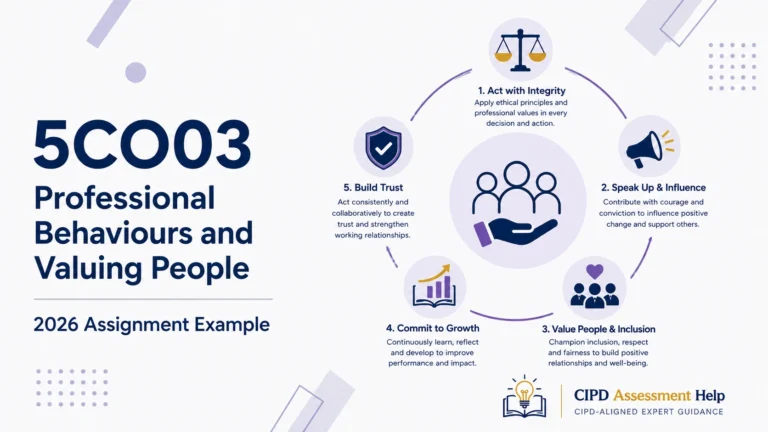
5CO01 — Organisational Performance and Culture in Practice
The most-referred Level 5 unit. Requires applied analysis of organisational structure and culture using a case study. Saudi learners must connect structural analysis to how Saudi organisations — with their specific governance structures, family-ownership models, and Saudisation-driven workforce composition — operate differently from the UK organisations the case study is based on. See the full 5CO01 assignment example →
5HR01 — Employment Relationship Management
Requires employment law application. Saudi learners must reference the Saudi Labour Law (Royal Decree M/51), not UK employment legislation, when discussing termination, grievance procedures, and worker rights. The 2023 amendments to contract types and notice periods are particularly relevant. See the 5HR01 assignment example →
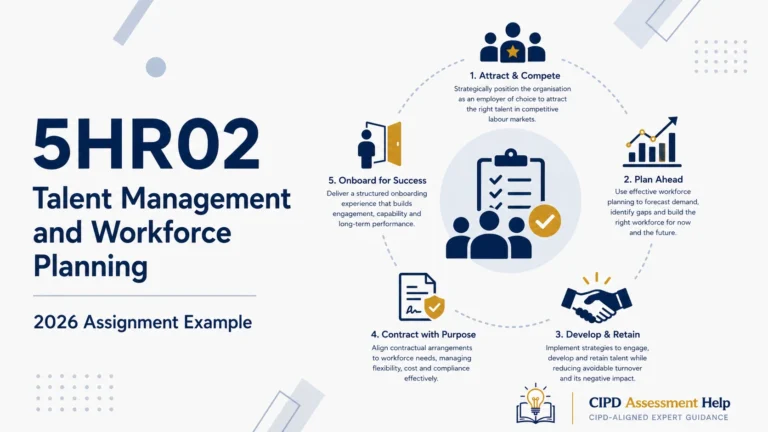
5HR02 — Talent Management and Workforce Planning
Saudisation (Nitaqat) is the defining constraint for workforce planning in any Saudi organisation. This unit requires you to discuss resourcing and talent strategies — doing so without addressing nationalisation quotas, HRDF training programmes, and the specific challenges of attracting and retaining Saudi nationals produces answers that miss the context assessors expect.
5CO02 — Evidence-Based Practice
Requires you to demonstrate how HR decisions should be informed by data and evidence. Saudi learners can draw on GOSI data, Ministry of Human Resources statistics, and Jadarat (the national skills framework) as evidence sources that UK-based learners do not have access to. See the 5CO02 assignment example →
Level 7 — Strategic Units
7CO01 — Work and Working Lives in a Changing Landscape
Requires analysis of how macro-economic, social, and technological trends are reshaping work. For Saudi learners, this means Vision 2030 economic diversification, the growth of NEOM and giga-projects, women’s workforce participation reforms, and the shift from an oil-dependent to a knowledge-based economy.
7CO02 — People Management and Development Strategies
Requires strategic-level analysis of how people management supports organisational objectives. Saudi learners working in government-linked organisations, Aramco supply chain companies, or Vision 2030 delivery entities have uniquely compelling strategic contexts that, when properly articulated, produce high-scoring submissions.
What Saudi Employers and Organisations Moses Has Contextualised For
Moses has mentored assignments contextualised to organisations across the Saudi economy, including:
- Government and semi-government: Ministry-linked organisations, Royal Commission entities, public sector HR departments operating under Civil Service regulations
- Energy and industrial: Aramco supply chain, SABIC, Ma’aden, and organisations operating under the National Industrial Development and Logistics Program (NIDLP)
- Giga-projects and Vision 2030 entities: NEOM, The Red Sea Development Company, Qiddiya, Diriyah Gate, and related development authorities
- Financial services: Saudi banks and insurance companies operating under SAMA and CMA regulatory frameworks
- Healthcare: Ministry of Health facilities, private hospital groups, and organisations aligned to the Health Sector Transformation Program
- Retail, hospitality, and entertainment: Organisations in sectors targeted by the Saudi Entertainment Authority and Tourism Development Fund
The specific organisational context is never generic. Moses researches your employer, your sector, and the regulatory environment your organisation operates in before structuring the assignment.
Ready to Start Your CIPD Assignment in Saudi Arabia?
Message Moses directly on WhatsApp for a free brief review. He’ll deconstruct your assignment brief, identify the Saudi-specific evidence you need, and map the command verbs to what the assessor expects — within 2 hours, at no cost.
WhatsApp Moses — Free Brief Review