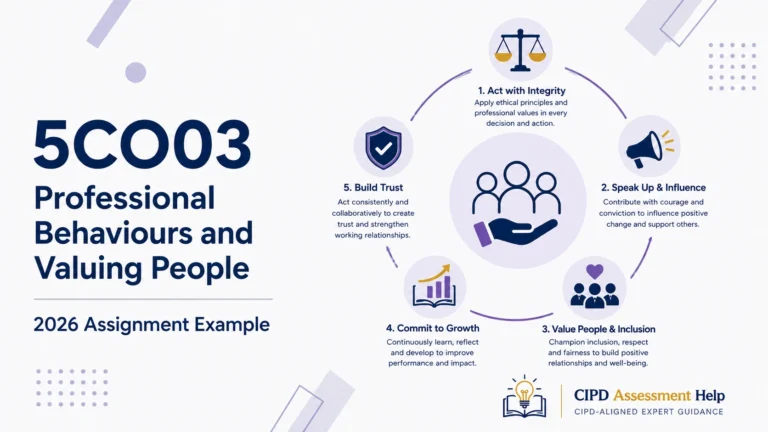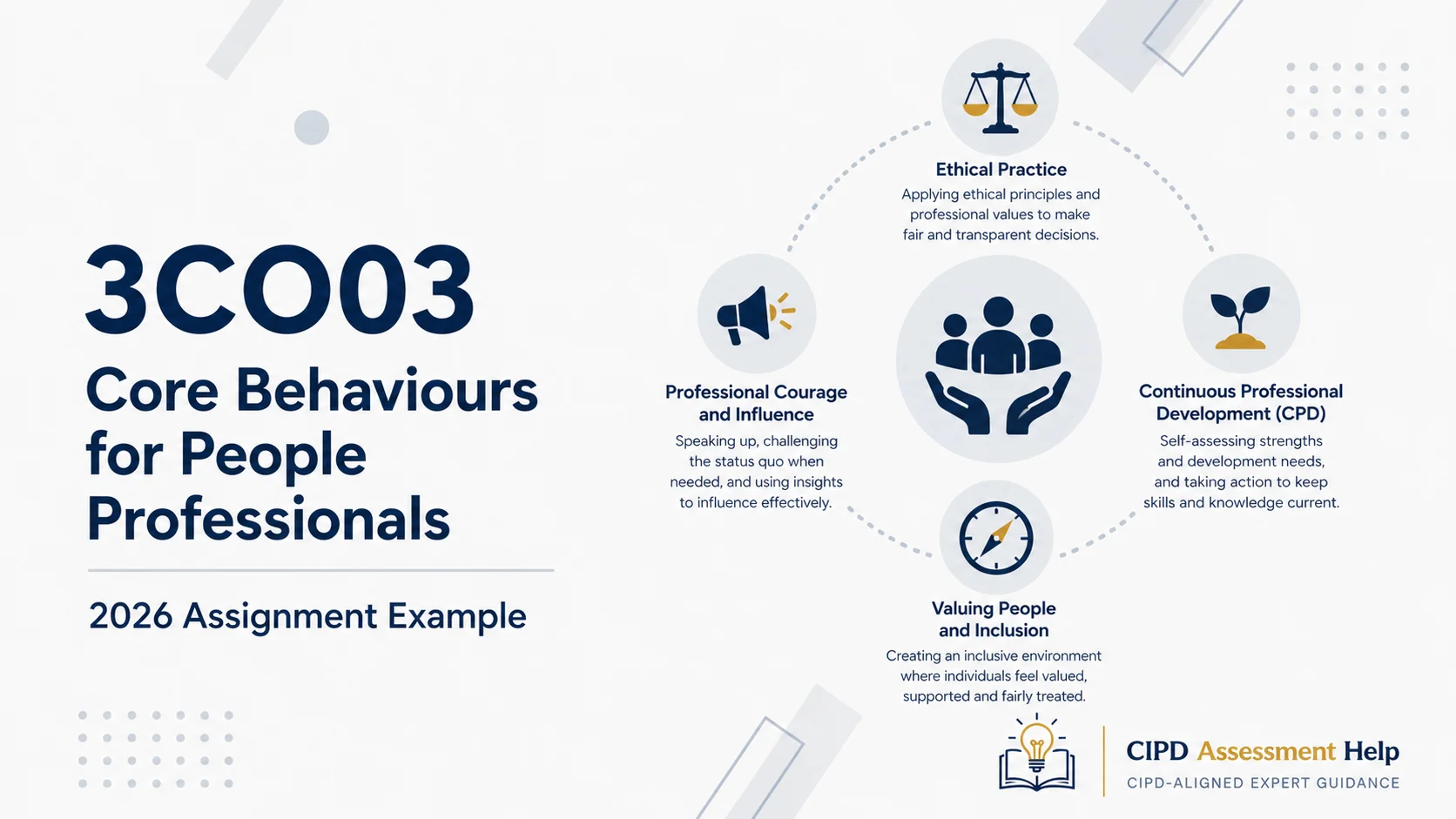
This is not an essay unit. The 2025/2026 3CO03 brief is structured as a job application to Nuvascare Ltd, a care company, and if you write your answers like academic coursework you will be referred. The brief says it plainly: responses must include “detailed examples from your previous work experience.” No hypotheticals. No generic statements about what HR professionals do. Your own experience, in your own words, applied to a specific employer.
Why the Format Matters More Than the Content
Nuvascare’s stated values are honesty, kindness, and openness. Those values are not background information. The best answers weave them into responses where they fit naturally, because the brief positions you as a candidate whose own values align with the organisation. Assessors are told to look for “excellent reference to the case study or scenario.” Ignoring Nuvascare throughout your answers will cost marks on every single question.
The shift from the other Level 3 units is significant. 3CO01 anchors everything to a business case study — you analyse BPE and Emrosu. 3CO02 puts you in an analytics role at Company X. Here, you are the case study. Your professional history is the evidence base. First person throughout. Specific personal examples. Answers that tell a story about you, not about people professionals in general.
Four written questions share a 2,000-word allocation (~500 each, ±10%). Q5 — the CPD record — sits outside that word count but is marked on the same 1–4 scale. A score of 1 on any question, including Q5, refers the entire submission. Exceeding 2,200 words loses the attempt entirely.
Why Reflection Matters More Here
Q1 — Two Parts, One Score
Q1 asks you to explain your understanding of ethical principles and professional values, and then give an example of how one of your values has informed your behaviour at work. Most learners handle the first part competently — they describe ethics frameworks, reference the CIPD code, write something polished. Then they get referred because the second part asks for context.
- Weak answer: “I demonstrated integrity by always being honest with colleagues”
- Strong answer: a specific account — the setting, the dilemma, the decision you made, the outcome
Spend roughly a third of your 500 words on the knowledge element and two thirds on the example. The example is where the marks differentiate.
Q3 — Three Examples, Not One
Q3 asks for three separate examples, each needing its own paragraph and its own distinct scenario:
- One showing how you contribute your views and opinions
- One showing how you clarify problems or issues
- One showing how you work effectively as part of a team
This is where the 500-word allocation becomes a discipline problem. Q3 absorbs more than its share if you are not careful. Learners who blend the three examples together or give only two score a 1. The marking descriptor for a Low Pass states the response must “include an appropriate example where this is required to support the answer.” For Q3, that means three distinct examples.
The same discipline around concrete personal examples runs through every reflective unit in the Level 3 Foundation Certificate. Building the habit now makes the entire qualification easier.
Q5 — The CPD Record Is Assessed
Q5 sits outside the 2,000-word count, so some learners treat it as an afterthought. It is assessed against AC 2.3 on the same 1 to 4 scale. A score of 1 on Q5 alone refers the whole submission.
The brief requires at least two development activities from the last two years, each with a reflection on how they impacted your practice. The guidance is specific:
- Not enough: listing a course you attended with a sentence about what you enjoyed
- What earns marks: how the learning altered something about how you work — the reflection on changed behaviour or approach is the substance of the mark
If you are also working through units that require evidence-based thinking at Level 5, the CPD discipline you build in 3CO03 feeds directly into the reflective practice expected at the next level.
Before You Write
- Nuvascare values — read the job advert in the brief. Understand honesty, kindness, and openness. Draw genuine connections between your values and theirs
- Word count — Q1–Q4 total must sit between 1,800 and 2,200 words. Exceeding 2,200 loses the attempt
- Q1 split — roughly one third knowledge, two thirds personal example
- Q3 structure — three separate examples, three separate paragraphs. Do not blend
- Q5 CPD record — minimum two development activities from the last two years, each with a reflection on changed practice
- First person — throughout. “I” not “a people professional would”
For a full breakdown of each learning outcome and assessment criterion, the 3CO03 unit guide covers what the marking descriptors expect. If you want your draft reviewed before submission, Moses responds within two hours — reach out via WhatsApp.
3CO03 Assignment Example 2026
AC 1.1
Understanding Ethical Principles and Professional Values
Ethical principles are essential guidelines that assist individuals in understanding what is right or wrong in the workplace. They make certain that decisions and actions do not infringe on the rights, dignity, and wellbeing of others and encourage responsible and transparent behaviour (CIPD, 2024). As a people practitioner, I tend to use the ethical principles by keeping proper and confidential records of employees. For example, when dealing with sensitive organisational information, I make sure that only authorised personnel have access to such information. This shows that privacy is respected and enhances ethical practices, which portray integrity and fairness in my day-to-day HR responsibilities.
Professional values are those behaviours and standards that are expected to be portrayed by a profession. They include aspects as honesty, respect, fairness, and integrity that help to understand how people communicate and act in their positions (Noor et al., 2024). I am able to reflect these values in my practice by treating the employees fairly, being considerate in my approach to concerns, and being open and honest in communication. This will assist in establishing trust, building relationships, and adding credibility to the organisation. It also fosters a sense of responsibility, where employees are respected and assured of processes within an organisation.
Applying a Core Value in Practice
One of the key professional values that form the basis of successful people practice is fairness. It means treating people equally, using the same procedures, and making decisions based on objective standards and not personal judgment (Kitterman, 2023). As a leader, I tend to be fair in various HR processes, such as recruiting and training. As an example, whenever we are undertaking training programs, I make sure that every employee has equal access to the learning and development opportunities so as to support their growth and development.
When assessing candidates for job roles, I make sure that I evaluate them objectively based on their skills, qualifications, and experience without prejudice. I also make sure that no applicant is evaluated based on different standards and align all the procedures involved in the process of evaluation to ensure that all applicants are treated equally. I also maintain effective communication during the process to make everyone aware of what is expected and make it clear to all applicants. Through the application of in these situations, I make sure that there is trust in HR practices and equality is advanced throughout the organisation.
Relevance to Nuvascare
The application of ethical principles and professional values is essential within organisations like Nuvascare. Fairness will make sure that the employees and candidates are subjected to equal treatment, policies will be treated equally, and development opportunities will be made in a manner that is accessible to everyone. These practices will help in the creation of a positive workplace culture which is founded on trust, respect, and cooperation. They will also resonate well with organisational values like honesty, kindness, and openness, and eventually enhance quality service delivery and organisational integrity.
AC 1.2
Compliance with the Data Protection
One of the major legal aspects that I tend to observe in my HR practice is that of complying with the data protection law. The Data Protection Act 2018 protects individuals against misuse of their personal data and mandates organisations to treat data with confidentiality, integrity, and accountability (Barbour, 2022). The Act also guarantees that no personal data is collected, stored, and processed without a legal basis, and also safeguards the privacy rights of individuals at all times.
In a previous HR role, I had to handle the employee records with regard to training and performance. Since this information is sensitive, I had to enforce strict security measures to ensure that the information is compliant. For example, I encrypted digital files, kept stored documents in password-protected systems, and made sure that only authorised individuals could access employee data. I also made sure that I had only retained information that was necessary in HR processes, and I applied the principle of data minimisation. These actions supported confidentiality, integrity, and professionalism, and enhanced trust between employees and the organisation.
This method will be critical at Nuvascare, where employee and client data will be managed safely and in a responsible manner in a care setting. It will also assist in gaining trust among service users and their families. This will be needed in convincing them that their personal information is being managed safely and ethically.
Compliance with the Health and Safety Requirements
One of the major legal requirements that I tend to follow in my HR practice is compliance with the health and safety legislation. The Health and Safety at Work etc. Act 1974 call upon employers to safeguard the health, safety, and wellbeing of workers and other people impacted by operations in the workplace to the extent that it is reasonably practicable (ACAS, 2025). This involves not only ensuring safe working conditions but also risk assessments, proper training, and supervision to minimise hazards at the workplace. To make sure that compliance takes place in my HR practice, I adhere to organisational health and safety protocols, report possible hazards as soon as possible, and assist with risk assessment where necessary. I also get to make sure that employees are informed of safety measures and how to act in case of risks. These actions can be implemented to prevent accidents, exposure to workplace hazards, and to ensure a culture of safety and responsibility. The compliance with this legislation at Nuvascare will assist in establishing a safer work environment among the staff and service users, decreasing the number of incidents and enhancing overall care quality. It will also contribute to the confidence of staff and their wellbeing as it will allow them to perform their work more efficiently in a secure and well-managed environment.
Continue Reading the Full 3CO03 Assignment
- All ACs complete & marked
- Editable Word document
- Harvard referencing throughout
- UK & GCC workplace context
- Marking descriptor alignment
- Updated for 2026 assessments