BPE has five pharmacies and a founder who built the business on personal service. Emrosu has a hundred stores, a board of directors, and an online platform. The 2025/2026 brief drops you into the middle of that acquisition and asks you to think like someone who has to make it work. If your answers read like a textbook chapter on mergers and acquisitions, you have already missed the point of 3CO01.
The Acquisition Is the Assessment
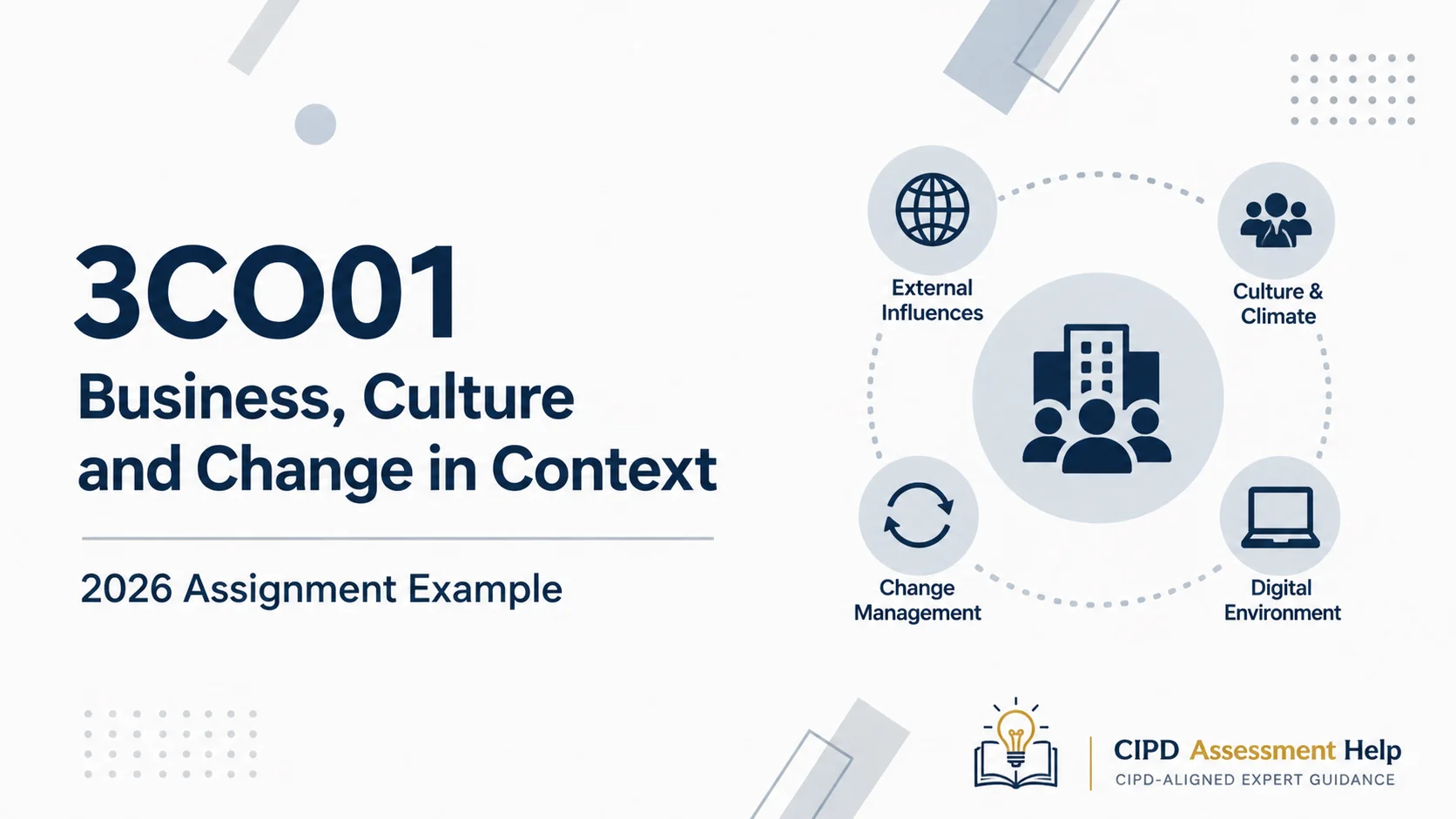
The brief (CIPD_3CO01_25_01) is titled Business, Culture and Change in Context. Every word in that title maps to a learning outcome — business environment under LO1, culture under LO2, change under LO3. Nine questions, 2,500 words, and a scenario where two fundamentally different organisations are about to collide.
The unit guide is direct: responses that describe models without connecting them to BPE and Emrosu will not pass. Your PESTLE analysis cannot be a list of generic factors. It has to explain what those factors mean for a five-store independent pharmacy absorbing a national chain with an existing internet operation.
Where LO1 Separates Passes From Referrals
Questions 1 through 4 cover the external environment, business goals, products and customers, and technology. The common mistake across all four is writing about pharmacies in general rather than about this pharmacy.
Q1 — External Factors
AC 1.1 asks for two external factors. Regulation is an obvious choice given NHS and GPhC oversight, but the question says “examine,” which means you need to go deeper than naming the factor. Show how it specifically complicates BPE’s move from five stores to a hundred. Technology is equally strong — Emrosu already has an internet pharmacy that BPE does not. That is not a background detail. It is a strategic tension your answer should explore.
Q2 — Business Goals
AC 1.2 asks for two business goals. The trap is writing goals that sound reasonable but could apply to any company. SMART goals tied to the actual post-acquisition situation — expanding digital prescription volumes using Emrosu’s platform, or building a unified training programme across a workforce that suddenly grew twentyfold — are what earn marks. If you are studying the Level 3 Foundation Certificate, this kind of applied thinking runs through every unit in the qualification.
Culture Is Not a Definition Exercise
Q5 and Q6 shift to organisational culture and systems thinking.
Q5 — Define Culture, Then Apply It
Q5 has two parts: define culture, then explain why it matters after this acquisition. Many learners spend 200 words defining culture and run out of room for the harder second part.
BPE runs flat — Shiva makes decisions with branch managers reporting directly. Emrosu runs through a board with layers of hierarchy. When those two structures merge, the cultures they carry merge too — or more often, they collide. Your answer needs to treat that collision as a live operational problem, not a theoretical discussion.
Q6 — Systems Thinking
Q6 asks how organisations function as whole systems. This is where evidence-based practice from 3CO02 becomes relevant. If you can connect the idea that one change in structure ripples through morale, retention, service quality, and customer experience, you are demonstrating the systems perspective the assessor is looking for.
Change Hits Each Workforce Differently
Questions 7 through 9 cover change management, the role of people professionals, and the human impact.
Q9 — The Question Most Learners Underestimate
AC 3.3 specifies that you should address how change impacts staff at BPE and at Emrosu separately. BPE employees are leaving a small, owner-managed business. Emrosu employees are arriving from a corporate chain. The same acquisition means something entirely different to each group, and a strong answer makes that contrast visible.
The 3CO03 unit on core behaviours deals with how people professionals handle change at a personal level. If you are working through both units, the connection between the organisational perspective here and the individual perspective in 3CO03 strengthens your answers in both.
Marking: What Actually Earns the Grades
Each question is marked 1 to 4. A score of 1 on any single question refers the entire submission. There is no compensation across questions.
What Gets You Through
Requires some evidence of reading and genuine engagement with the case study. At least one Harvard-referenced source per question and answers connected to BPE/Emrosu rather than generic theory.
What Earns the Higher Marks
A score of 4 asks for “an excellent level of knowledge,” strong examples, “excellent reference to the case study,” and evidence of wider reading — though the unit guide notes that strong practical application can compensate for a shorter reference list. Quality of analysis beats volume of citations.
Practical Checks Before Submission
- Brief version — confirm you have CIPD_3CO01_25_01 (BPE and Emrosu case study, released June 2025, expires June 2026)
- Word count — must sit between 2,250 and 2,750. Exceeding 2,750 triggers automatic referral
- Sub-parts — Q3, Q5, and Q6 each have two parts. Check both are answered
- Case study — every answer must apply BPE/Emrosu specifically, not just namecheck them
- Referencing — Harvard style throughout, with at least one source per question
The 3CO01 unit guide on this site walks through every question and what the marking descriptors require. If you want a second opinion on your draft, Moses is reachable on WhatsApp and usually responds within two hours.
3CO01 Assignment Example 2026
AC 1.1
Technological Factors
One significant external influence affecting the acquisition of Emrosu by BPE is technological advancement in digital healthcare. Due to the changing consumer preferences and the growing need of convenience post-pandemic, the pharmacy sector is rapidly shifting towards the delivery of services online and digitally in the UK (Mesko, 2018). Emrosu has already established an online pharmacy platform where customers can access prescriptions and home delivery services. This is an indication of the increased dependency on e-commerce and NHS support of digital health solutions.
For BPE, whose existing model is based on personal service and a local, family oriented culture, integrating Emrosu’s digital operations presents both opportunities and challenges. On one hand, digital technology can enable BPE to expand its reach nationally and diversify its service offering. Digital infrastructure investment, employee training, and customer engagement strategies will be necessary in order to help ensure the integration is successful.
Regulation and Legal Requirements in Pharmacy Operations
Another key external factor is the regulatory and legal environment within the healthcare and pharmaceutical sector. The pharmacies in the UK are controlled with strict regulations and should meet the requirements about prescribing medications, patient safety, and immunisations (GOV.UK, 2022). The decision to purchase a major national chain like Emrosu will render BPE more vulnerable to the scrutiny of the regulatory authorities including the General Pharmaceutical Council (GPhC), where it will be forced to comply with a significantly larger workforce and distribution network.
This is driven by the government’s emphasis on safe and accessible healthcare, as well as the growing reliance on pharmacies to ease pressure on the NHS. In the case of BPE, compliance risks are raised by having five stores grow to one-hundred stores, so it becomes necessary to have consistency in operating guidelines and proper record keeping, especially in digital systems. However, meeting these regulatory requirements also provides BPE with an opportunity to strengthen its credibility as a national healthcare provider.
AC 1.2
Post-Acquisition Strategic Goals
Following the acquisition of Emrosu, one of BPE’s key strategic goals is to expand its customer base nationwide, particularly by strengthening its digital services. Emrosu already has a developed online pharmacy platform in place so that BPE could establish a SMART goal to grow national online prescription volumes over the next few months. This would assist the organisation in becoming not only a small regional chain but also a wider national provider, where customers in various locations can easily and readily access the services. It would also enhance competitiveness in a more digital healthcare market.
The second goal is to increase the workforce capability in all branches with the aim of providing a consistent quality of service. The objective is to incorporate organisations and teams and establish a common standard of practice. An example of a SMART target would be to provide a structured national training programme and make all employees go through it within a time span, such as a year. This becomes particularly significant following the acquisition where employees will be required to adjust to new systems, expectations as well as organisational process without lowering the standards of services.
Role of Planning in Achieving Organisational Goals
Effective planning is essential to translating strategic goals into practical outcomes. This involves creating timelines, assigning responsibilities, and monitoring progress. For BPE, a phased approach to integration, starting with high-priority areas like compliance and training, would reduce the risk of disruption. Regular reviews against SMART targets would allow management to identify issues early and adjust strategies accordingly, helping ensure that the acquisition delivers the intended benefits for both the workforce and the customers it serves.