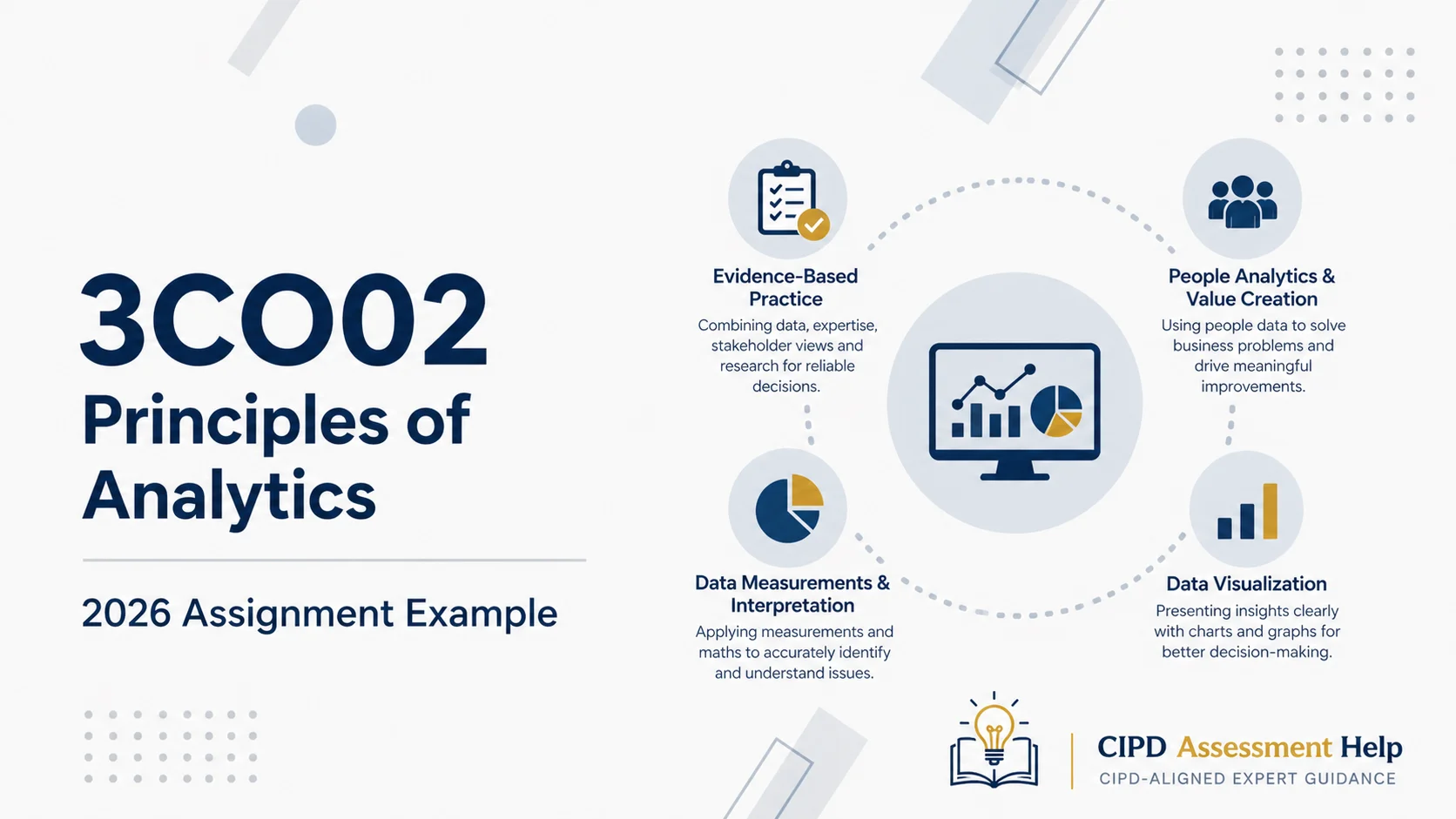
Three different types of evidence in a single submission. That is what 3CO02 demands, and it is the reason this unit has a higher referral rate than most learners expect from something called Principles of Analytics.
You are not writing one long essay. You are producing written answers, a data calculation with a table, and two visual diagrams — each assessed against different criteria, each with its own rules. Treating the whole thing as a single written piece is one of the fastest routes to a referral.
The Company X Scenario Shapes Everything
The 2025/2026 brief (CIPD_3CO02_25_01) puts you inside a job application. You are applying for a People Analytics Administrator role at Company X, an HR solutions provider. The team you would be joining has limited data management experience, which is why the position exists.
That framing is not decoration — it tells you exactly how your answers should read. You are demonstrating competence to an employer, not submitting coursework to a tutor. Abstract explanations of what evidence-based practice means in theory will not land the same way as showing how Company X could use employee data to solve a specific operational problem.
Your submission has three distinct sections with different rules: written answers to Q1–Q6 (~1,500 words combined, ~250 per question, Harvard referencing required), a calculation table plus written analysis for Q7 (~500 words, table before analysis), and two diagrams for Q8 (no word count, but any narrative you add counts toward the total). The permitted range across Q1–Q7 is 1,800–2,200 words. Exceeding 2,200 loses the attempt entirely. A score of 1 on any single question refers the whole submission — there is no compensation across questions.
The Calculations and Formats That Trip People Up
Q7 — The Percentage Calculation
Question 7 gives you an Excel table of overtime hours from Blue Mountain Patisserie, a client of Company X. You need to calculate average overtime per employee and express those averages as a percentage of normal working hours.
The calculation is basic arithmetic. The problem is the denominator. Normal working hours is the base figure for your percentage — not total hours including overtime. Using the wrong number means every row in your table is wrong, and the 500-word analysis falls apart.
After the maths, you are analysing, not describing:
- Description (weak): “Employee A worked more overtime than Employee B”
- Analysis (strong): identifying a pattern suggesting a department is consistently understaffed and recommending what Company X should advise its client to do about it
The ability to move from raw data to actionable insight is exactly what the Level 3 qualification is designed to develop.
Q5 — The Three Groups You Must Not Forget
AC 2.1 asks how people professionals at Company X create value for three groups. All three must be addressed to pass. Writing 300 strong words that only covers two of the three will score a 1:
- Their people — employees within Company X
- Their organisation — Company X’s own strategic objectives
- Their wider stakeholders — includes clients like Blue Mountain Patisserie, whose outcomes depend on Company X doing its job well
A standalone paragraph per group is the safest structure. The link between the written questions and the calculation task is not accidental — the same client whose data you analyse in Q7 is an example of a wider stakeholder here.
If you are working through the full Level 3 programme, the value-creation question connects naturally to 3CO01’s business goals discussion, where you are also expected to show how people practice creates tangible organisational outcomes.
Q6 — First Person Works Better
AC 2.2 asks you to imagine you got the job and describe how you would be customer-focused and standards-driven in the role. The brief allows first or third person, but first person is sharper. “I would use the CIPD Profession Map to guide my approach to evidence-based decisions” is more direct than the third-person alternative.
The standards element should reference professional courage, ethical practice, and evidence-based working — all Profession Map behaviours that demonstrate wider reading without needing a separate academic source.
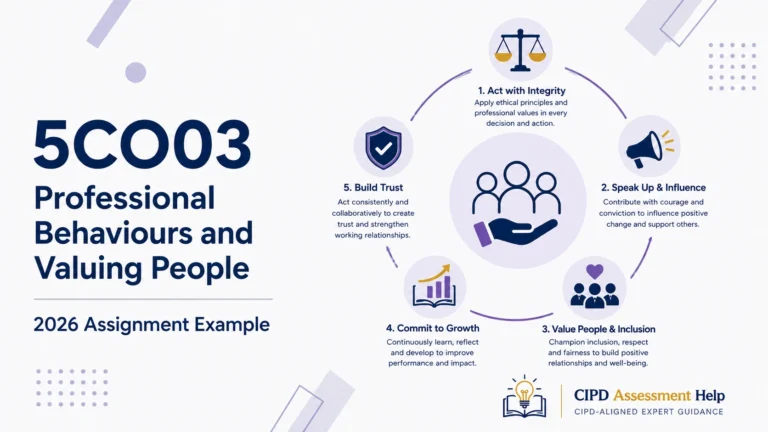
The customer-focused framing here sits alongside what 3CO03 covers on professional behaviours. If you are doing both units, the overlap is worth understanding — your answer to Q6 here and your answers about professional values in 3CO03 should reinforce each other.
Two Final Checks
First: confirm your total across Q1–Q7 sits between 1,800 and 2,200 words. Going over 2,200 costs you the submission entirely — that is not a referral, it is a lost attempt.
Second: make sure Q7 has the completed calculation table before the written analysis, not after it and not instead of it. Use normal working hours as your denominator for percentages. Check Q8 has two clearly distinct diagram types — not two versions of the same format. And verify Q5 addresses all three groups (people, organisation, wider stakeholders).
The 3CO02 unit guide on this site covers every AC and what the marking descriptors expect. Need a draft reviewed? Moses is available on WhatsApp and typically turns feedback around within two hours.
3CO02 Assignment Example 2025–2026
AC 1.1
Understanding Evidence-Based Practice
Evidence-based practice can be considered a decision-making process that entails the careful application of reliable and relevant information (Boatman, 2024). It entails the collection of data, its critical analysis, and the use of the data to take steps in a structured manner. This would make sure that the decisions associated with people management are objective, effective, and goal oriented (Boatman, 2024). It involves problem recognition, evidence collection, evaluation of evidence quality, practice of using the knowledge and evaluation of the findings to support the process of continuous improvement.
There are four major sources of evidence involved in this approach. They include academic or workplace research, organisational data (employee turnover, odds of engagement), stakeholder input (employees, managers, customers), and professional knowledge gained through experience (CIPD, 2025). These sources together give a well-informed basis on decision making.
Applying Evidence-Based Practice
This method can be used in the creation of a recruitment and selection plan at Company X. HR will be able to use previous recruitment information to find out the most successful hiring sources, study existing studies on inclusive hiring, and obtain feedback on managers and candidates (Chown, 2024). This makes recruitment processes effective, equitable, and in accordance with organisational requirements.
EBP may also be applied in enhancing performance management systems. HR will be able to analyze internal performance data and engagement surveys to notice gaps, research on best practices regarding feedback and appraisal techniques, and engage employees in the process of system development. This assists in the development of a process that boosts productivity, promotes equity, and boosts the satisfaction of all employees, in addition to achieving business goals.
AC 1.2
Value of Accurate Data
Accurate data is significant in assisting organisations to identify, understand, and resolve problems in the workplace effectively. Reliable information gives a better and more realistic view of organisational problems, thereby allowing people professionals to make informed and objective decisions (Montgomery, 2025). Accurate and complete data help to make evidence-based actions, which have a higher chance of positive outcomes. In contrast, inaccurate or incomplete data is likely to lead to poor analysis of the problem, ineffective strategies, and wastage of resources. With accurate data at Company X, decision-makers can work on the underlying causes of problems, instead of relying on assumptions or limited information. This enhances the quality of interventions and ensures that solutions are targeted and effective. It also encourages fairness and transparency in the decision making process that aids in the establishment of trust among employees, clients and other stakeholders.
Example of Data Driven Decision Making
An example of using data effectively at Company X would be analysing employee absence patterns to identify whether certain departments have higher rates of unplanned leave. By collecting accurate data on absence frequency, duration, and reasons, the People Analytics team could identify whether the issue is linked to workload, management practices, or health-related factors. This evidence would inform targeted interventions rather than applying a blanket policy, demonstrating how accurate data leads to better outcomes for both employees and the organisation.