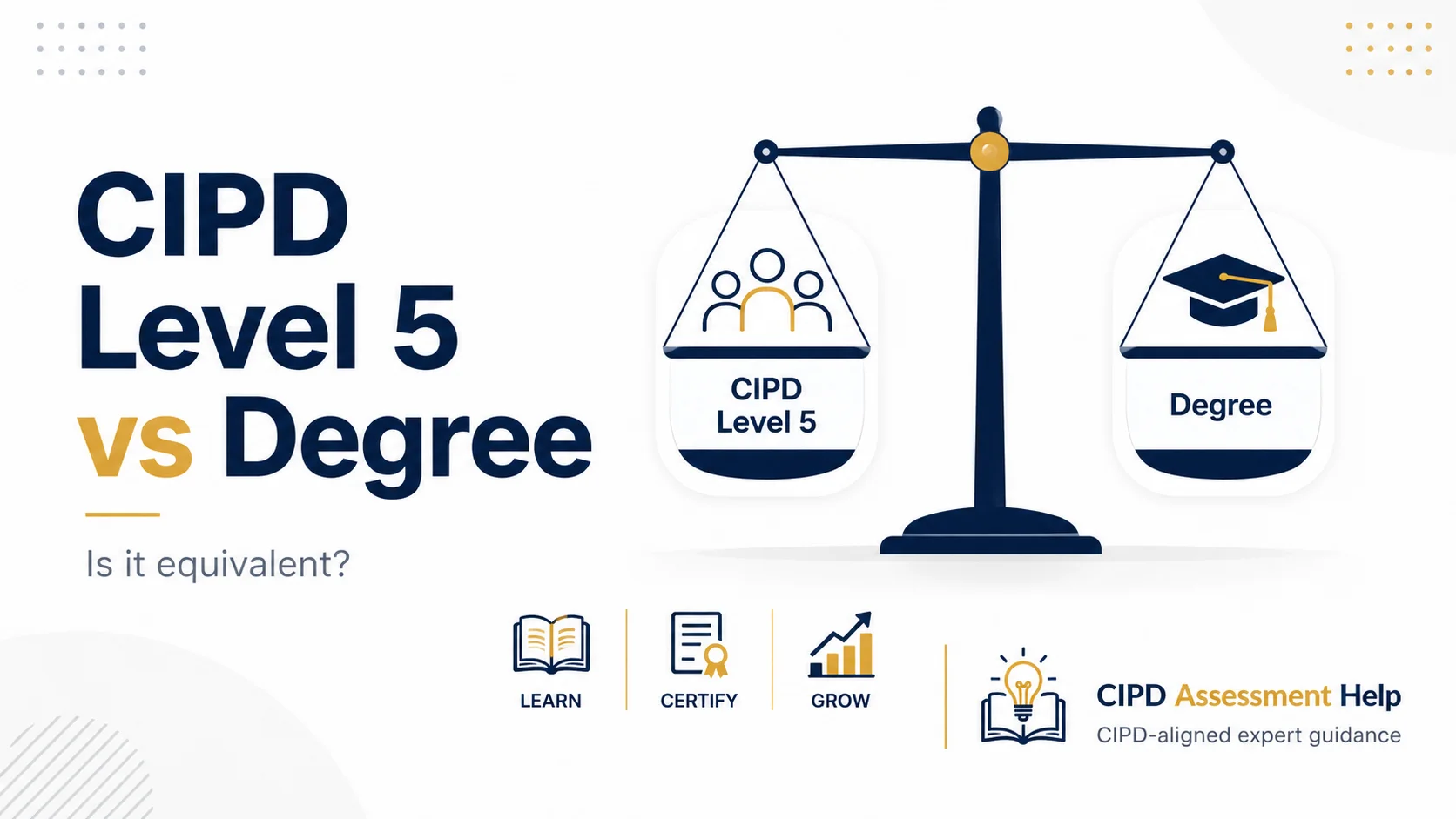
If you are asking whether CIPD Level 5 is equivalent to a degree, the short answer is: not quite — but for HR careers, it often carries equal or greater weight. CIPD Level 5 is a Regulated Qualifications Framework Level 5 qualification, which places it at the same academic level as a Foundation Degree or the second year of a UK Bachelor’s. It is not a full honours degree — that sits one level higher at RQF Level 6. For most HR careers in the UK and across the GCC, this distinction makes very little practical difference. For a small number of situations — applying to certain Master’s programmes, or seeking formal degree recognition from bodies like the Saudi Ministry of Education — it matters a great deal. The question is not which answer is right in the abstract. It is which answer is right for your specific situation.
Most articles on this topic stop at the framework definition. They tell you what CIPD Level 5 is equivalent to on the ladder and leave it there. What they do not tell you is how a recruiter in Dubai actually reads a CIPD qualification on a CV, or why so many UK HR job advertisements list CIPD Level 5 in the same breath as a degree rather than below it. That context is where the real answer lives.
Where CIPD Level 5 Sits on the RQF
The Regulated Qualifications Framework is the official scale used in England, Wales and Northern Ireland. Every formal qualification has a level. CIPD Level 5 sits at Level 5, which is below a full honours degree but above a Higher National Certificate. The ladder looks like this:
So what is CIPD Level 5 equivalent to in academic terms? A Foundation Degree or HND — one level below a full Bachelor’s. The gap between Level 5 and Level 6 comes up in one concrete scenario: postgraduate entry requirements. Most universities specify a full undergraduate degree (Level 6) as the entry point for a Master’s. A standalone CIPD Level 5 will not automatically satisfy that requirement. Some institutions consider professional experience and qualifications together, but you need to check individually — do not assume. For everything outside that scenario, the Level 5 versus Level 6 gap is far less significant in practice than the framework implies on paper.
The reason for this is something most articles on this topic overlook. Academic level and professional value are two different measurements. CIPD Level 5 is not trying to replicate what a three-year degree does. It is doing something different: building applied HR competence, assessed through work-based evidence, and validated by the professional body that sets the standard for the UK people practice industry. Recruiters who hire HR professionals understand that distinction. It is why the qualification carries the weight it does.
Is CIPD Level 5 Equivalent to a Masters?
No. CIPD Level 5 is not equivalent to a Master’s degree. A Master’s sits at RQF Level 7 — two full levels above Level 5. It is CIPD Level 7 (the Advanced Diploma in Strategic People Management) that sits at Master’s-equivalent level, not Level 5. This is a common misconception, particularly among GCC learners who hear “CIPD” and “postgraduate” in the same sentence without understanding which level is being referenced.
If your goal is a Master’s-equivalent HR qualification, CIPD Level 7 is the route. Level 5 is the mid-career professional qualification — it builds the foundation, earns you Associate CIPD membership, and positions you for HR Advisor and Business Partner roles. Level 7 is the strategic qualification that leads to Chartered CIPD membership and sits alongside an MSc in HRM on the qualifications framework.
What UK Employers Actually See
In the UK, CIPD Level 5 Associate Diploma is widely treated as the benchmark qualification for HR Advisor, People Manager, and junior HR Business Partner roles. Job boards bear this out. Search for HR Advisor roles across the major UK platforms and a consistent pattern appears: the qualification requirement reads “degree or CIPD Level 5” — not “degree, with CIPD Level 5 as a less preferred alternative.” They sit in the same sentence because, for those roles, they carry similar weight.
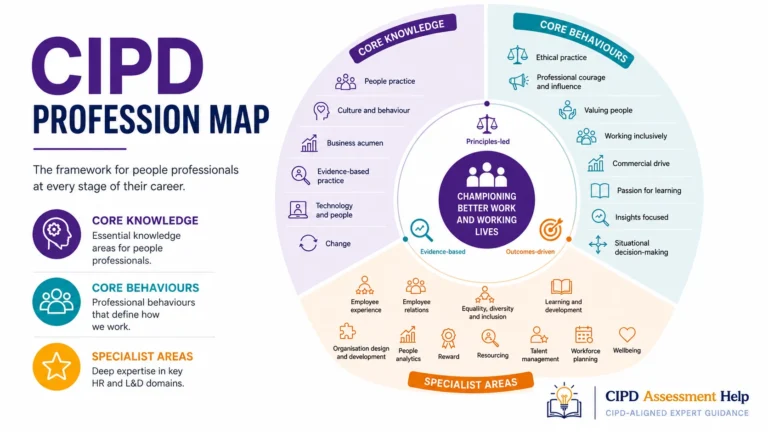
The reason is the professional outcome. A degree tells a recruiter you completed an academic programme. CIPD Associate membership tells them you have been assessed against a defined professional standard — the CIPD Profession Map — and that you are accountable to a regulated body. For employers who need someone to manage employee relations cases, run recruitment campaigns, or advise line managers on performance issues from day one, the latter is the more useful signal.
“Many job advertisements in the UK phrase their requirements as ‘degree or CIPD Level 5’ rather than treating one as superior to the other. That phrasing is not accidental. It reflects how the profession actually values both routes.”
The comparison below sets out where the two credentials differ in ways that matter for career decisions, not just academic classification.
| Factor | CIPD Level 5 Associate Diploma | BA/BSc in HR or Business |
|---|---|---|
| RQF Level | Level 5 (Foundation Degree equivalent) | Level 6 (Full Honours degree) |
| Duration | 8 to 12 months, part-time | 3 to 4 years, full-time |
| Typical UK cost | £2,000 to £4,500 depending on provider | £27,000 and above over three years |
| HR content | Deep and applied — employment law, people management, evidence-based practice, reward | Variable — often broad business scope with HR as one strand among many |
| Assessment style | Work-based assignments anchored to your own organisation | Essays, exams, dissertations — largely theoretical |
| Professional outcome | Associate CIPD membership (Assoc CIPD) | Graduate status — no automatic professional body membership |
| Typical career entry | HR Advisor, People Manager, Business Partner roles | Graduate schemes — often requires further experience for senior HR roles |
| Masters entry | Not automatically — check with the institution individually | Generally accepted as standard entry requirement |
Certificate or Diploma: The Confusion Nobody Explains Clearly
CIPD Level 5 comes in two versions and the difference between them matters more than most learners realise before they enrol. The Certificate covers fewer modules and completes faster. The Diploma covers the full syllabus and leads to Associate CIPD membership.
Both sit at RQF Level 5. But only the Diploma earns you the Assoc CIPD designation — the actual membership designation that appears after your name on a CV and that recruiters look for when they list CIPD Level 5 as a requirement. If you are enrolling in order to compete with degree-qualified candidates for HR roles, the Certificate will not achieve that. The Diploma is the version that does the work.
The Certificate makes sense if you already hold a degree and are adding a recognised HR credential rather than building your primary qualification from scratch. If HR is your intended career and you do not yet have a degree, the Diploma is the only version worth considering.
What This Means If You Work in the GCC
For learners based in Saudi Arabia, UAE, Qatar, or elsewhere in the Gulf, the answer to this question has an extra layer that most UK-focused providers do not address honestly.
The Saudi Ministry of Education and equivalent bodies in the GCC do not recognise CIPD Level 5 as an academic degree equivalency. If you need to demonstrate a full undergraduate qualification for official purposes — university entry in another field, government employment classifications, or certain visa categories — CIPD Level 5 will not satisfy that requirement. It is worth being direct about this because some learners expect otherwise, and finding out late costs time and money.
What the qualification does do in the GCC is something that a generic regional business degree often cannot. Firms like Saudi Aramco, NEOM, Deloitte, PwC, and the Emirates Group recruit to CIPD-standard HR roles and frequently list Assoc CIPD as a preferred or required qualification. This is not because the framework is formally mandated in those markets. It is because organisations that operate to international people management standards use CIPD as their professional benchmark, and they know what the designation means.
For Saudi nationals working within Nitaqat compliance structures, or HR professionals supporting Vision 2030 workforce development programmes, holding a CIPD qualification also signals something specific: that you can apply internationally recognised frameworks to a Saudi organisational context. That combination is exactly what employers building out people functions in the Kingdom are currently recruiting for. A generic business degree from a regional university does not demonstrate that. A CIPD Level 5 Diploma, applied through GCC-contextualised assignments, does.
If you are working through your Level 5 units and need support contextualising your assignments to the GCC, see the Level 5 unit guides on this site — each unit page covers the specific risks in the current assessment brief and what passing answers require. Moses also provides a free brief review for learners at any stage.
When a Full Degree Is Still the Right Answer
CIPD Level 5 is not the right choice for every situation, and it is worth being clear about that rather than overselling it.
If you are 18 or 19, have no degree, and have time available, a full undergraduate degree in HRM gives you a broader academic foundation, opens graduate scheme routes that CIPD alone does not, and satisfies Master’s entry requirements across disciplines without needing individual assessment. The three-year investment makes sense at the start of a long career, particularly if you are not yet certain you want HR as your permanent direction.
If you are already working in HR, or switching into people practice from another profession, CIPD Level 5 almost always delivers a faster and more direct return. The assessments use your actual workplace as the context, you finish in under a year, and you leave with both a qualification and a professional designation. For working professionals in their late twenties or older — which describes the majority of GCC learners — the case for a three-year degree over CIPD Level 5 is genuinely difficult to make.
The next step after Level 5, for those who want to continue building, is CIPD Level 7. It sits at RQF Level 7, is treated as postgraduate equivalent, and leads to Chartered CIPD membership. That is the qualification for senior HR leaders and those targeting strategic or director-level roles.
Need Help with Your CIPD Assignment?
Moses provides GCC-contextualised CIPD mentoring for Level 3, 5, and 7. Free initial brief review — replies within 2 hours.
WhatsApp Moses NowFrequently Asked Questions
Is CIPD Level 5 the same as a degree?
No. It sits at RQF Level 5, equivalent to a Foundation Degree or the second year of a UK Bachelor’s. A full honours degree is Level 6. The academic levels differ, but for HR roles in the UK and GCC, employers frequently treat them as equivalent in practice — many job advertisements list “degree or CIPD Level 5” as the same acceptable qualification.
Can I get an HR job with CIPD Level 5 and no degree?
Yes, and it is common. HR Advisor, People Manager, and HR Business Partner roles across the UK and GCC regularly list CIPD Level 5 as a standalone acceptable qualification. The Assoc CIPD designation often carries more practical weight than a general business degree for HR-specific roles.
Is CIPD Level 5 equivalent to a Masters degree?
No. CIPD Level 5 sits at RQF Level 5, while a Master’s degree sits at Level 7. It is CIPD Level 7 (the Advanced Diploma in Strategic People Management) that holds Master’s-equivalent status and leads to Chartered CIPD membership. Level 5 is two full framework levels below a Master’s.
Can I use CIPD Level 5 to apply for a Master’s degree?
Not automatically. Most Master’s programmes specify a full undergraduate degree (Level 6) as the entry requirement. Some universities consider professional experience alongside a Level 5 qualification, but check directly with the institution — do not assume. This is the one scenario where the gap between Level 5 and Level 6 genuinely matters.
Is CIPD Level 5 recognised in Saudi Arabia and the UAE?
As a professional qualification, yes, widely. As an academic degree equivalency for Ministry of Education purposes in Saudi Arabia, no. Multinational and large national employers in the GCC use CIPD as their benchmark for HR professional standards, and Assoc CIPD membership carries real weight in hiring and progression decisions for people management roles.
What is the difference between the CIPD Level 5 Certificate and Diploma?
The Certificate covers fewer modules and completes faster. The Diploma covers the full syllabus and leads to Associate CIPD membership. Only the Diploma earns you the Assoc CIPD designation. If you want the qualification to carry equivalent weight to a degree in HR job applications, the Diploma is the version that achieves that.
What comes after CIPD Level 5?
CIPD Level 7, which sits at RQF Level 7 and is treated as postgraduate equivalent — comparable to a Master’s degree. It leads to Chartered CIPD membership and is the standard for senior HR leadership and strategic roles. See the Level 7 overview for more detail on what the qualification covers and who it suits.
Which is better for HR jobs: CIPD Level 5 or a university degree?
For HR-specific roles, CIPD Level 5 is frequently more useful. It is applied, leads to a professional designation, and is completed in a fraction of the time and cost. A general business degree opens broader doors and satisfies more academic entry requirements. If HR is your intended career, CIPD is the direct route. If you want to keep wider options open, a full degree gives you more flexibility — but significantly more time and money is required to get there.