The CIPD Profession Map is the framework that defines what it means to be a people professional. It appears in every CIPD qualification — at Level 3 you describe it, at Level 5 you apply it to your professional development, and at Level 7 you critically evaluate it.
Yet many learners treat it as a diagram to reproduce rather than a framework to engage with. This guide explains what the Profession Map actually contains, how it works as an analytical tool, and how to use it effectively in your assignments at every level.
What Is the CIPD Profession Map?
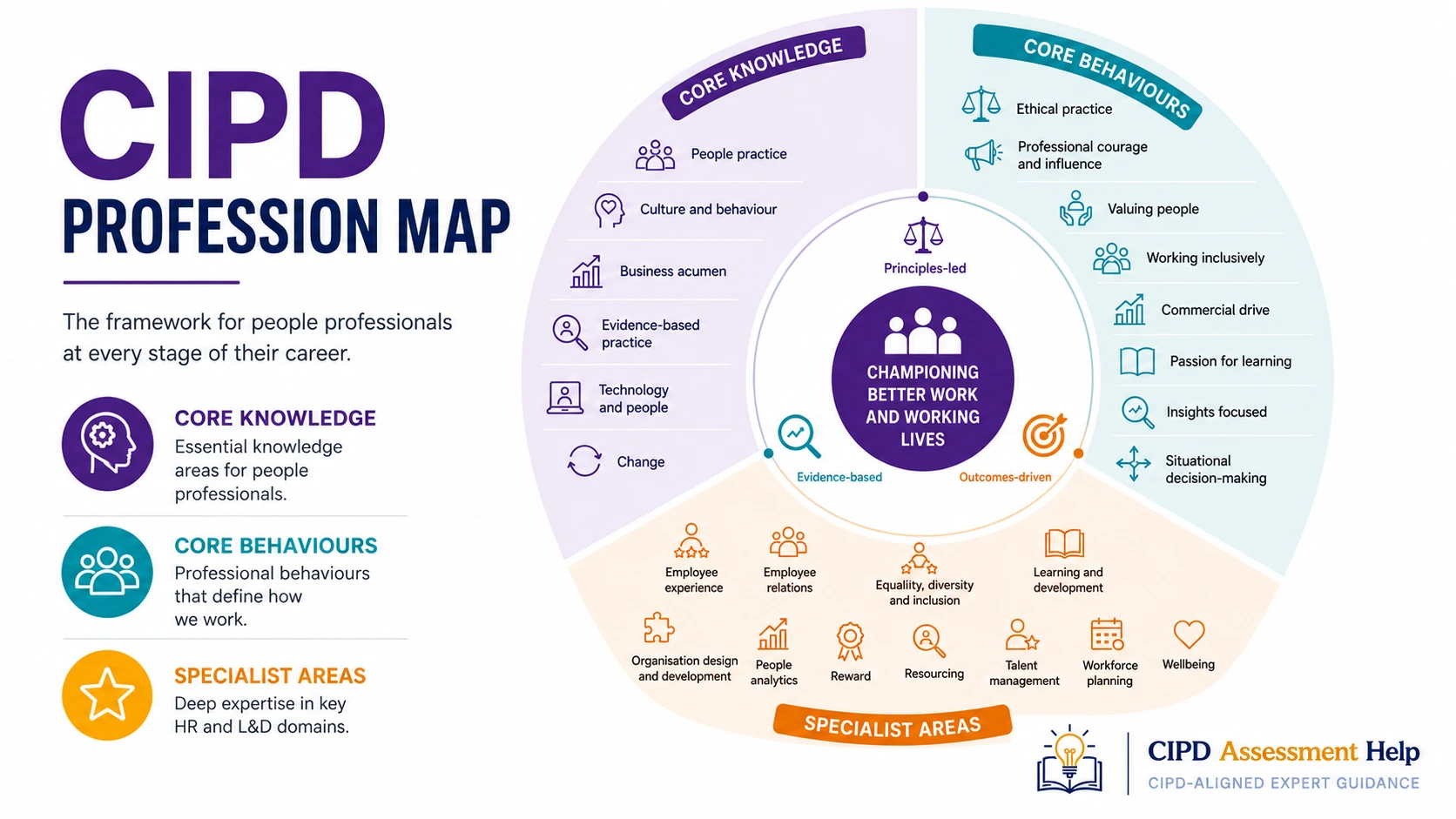
The CIPD Profession Map (updated 2018, with ongoing revisions) defines the knowledge, behaviours, and values that people professionals need at every stage of their career.
The CIPD Profession Map provides the professional framework that guides HR and people practitioners throughout their careers. Whether you are studying Level 3, working through the CIPD Level 5 Associate Diploma, or progressing to Level 7, understanding how the Profession Map works is essential for assignments, reflective practice, CPD planning, and professional development.
It is organised into three interconnected components:
- Core Knowledge: What you need to know — the technical and professional knowledge areas
- Core Behaviours: How you need to act — the professional behaviours expected of people practitioners
- Specialist Knowledge: Deep expertise in specific HR and Learning & Development domains
At the centre of the map is the purpose of the people profession:
“Championing better work and working lives.”
This purpose statement is not decorative. It frames everything else in the Profession Map and should inform how you discuss the profession in your assignments.
How to Use the CIPD Profession Map in Assignments
The way you engage with the Profession Map changes depending on qualification level. At Level 3 learners explain the framework, at Level 5 they apply it to their own development, and at Level 7 they critically evaluate its assumptions and relevance.
CIPD Level 3 (3CO04, 3CO01)
What is expected: Describe the Profession Map — what it contains, how it is structured, and what its purpose is. Explain how specific elements relate to your current or target role.
How to do it well:
- Do not reproduce the map without explanation
- Identify behaviours relevant to your role
- Connect knowledge areas to workplace activities
- Use the map to identify development priorities
Example:
“The CIPD Profession Map identifies ethical practice as a core behaviour for people professionals. In my HR Coordinator role, ethical practice appears through confidential data handling, objective recruitment decisions, and impartial employee relations processes.”
CIPD Level 5 (5CO03)
What is expected: Apply the Profession Map to your professional development. Evaluate your strengths, identify development priorities, and create development objectives.
How to do it well:
- Conduct genuine self-assessment against core behaviours
- Use reflective models such as Gibbs or Kolb
- Create measurable development objectives
- Apply learning to organisational context
Example:
“Evaluating my practice against professional courage and influence identified a development need. I recognised occasions where organisational hierarchy affected my willingness to challenge decisions constructively.”
CIPD Level 7 (7CO03)
What is expected: Critically evaluate the Profession Map itself. Assess assumptions, limitations, applicability, and professional relevance.
How to do it well:
- Critically assess cultural applicability
- Evaluate evidence-based practice assumptions
- Compare against alternative professional frameworks
- Analyse whether behaviours apply universally across contexts
Critical questions to explore:
- Is the Profession Map universally applicable?
- Does it reflect Western professional assumptions?
- Does behavioural emphasis adequately balance competencies?
- How does it compare to SHRM competency frameworks?
Core Knowledge Areas
The Profession Map identifies core knowledge that all people professionals need regardless of specialisation.
1. People Practice
Understanding the employee lifecycle — recruitment, development, reward, employee relations, employment law, and operational HR processes.
2. Culture and Behaviour
Understanding organisational culture, employee behaviour, organisational development, and the factors that influence workplace performance.
3. Business Acumen
Understanding strategy, financial performance, commercial awareness, and how people strategy contributes to business outcomes.
4. Evidence-Based Practice
Using evidence, analytics, and data to create insight, solve problems, develop ideas, and measure the impact of people interventions.
5. Technology and People
Understanding the impact of technology on people at work — HR systems, AI in HR, the digital employee experience, and how technology shapes people practice.
6. Change
Understanding organisational change, stakeholder management, and the role of people professionals in transformation processes.
Core Behaviours
The Profession Map defines behaviours expected of all people professionals.
1. Ethical Practice
Acting with integrity, balancing organisational priorities with employee wellbeing, and demonstrating moral courage.
What assessors look for:
Evidence of ethical judgement rather than simply stating ethical intentions.
2. Professional Courage and Influence
Speaking up constructively, influencing stakeholders, and challenging decisions where necessary.
3. Valuing People
Treating people fairly, promoting inclusion, and recognising individual contribution.
4. Working Inclusively
Supporting diversity, inclusion, psychological safety, and equitable workplace practices.
5. Commercial Drive
Connecting people practice to organisational performance and sustainability.
6. Passion for Learning
Demonstrating continuous development and professional growth.
7. Insights Focused
Using evidence and analytical thinking to improve decision quality.
8. Situational Decision-Making
Making balanced decisions within complex organisational contexts.
Specialist Knowledge Areas
Alongside core knowledge and behaviours, the Profession Map includes specialist pathways that support deeper expertise.
- Employee Experience
- Employee Relations
- Equality, Diversity and Inclusion
- Learning and Development
- Organisation Development and Design
- People Analytics
- Resourcing
- Reward
- Talent Management
- Wellbeing
These specialist areas align closely with CIPD pathways and the advanced professional development routes studied at postgraduate level.
Why the CIPD Profession Map Matters
The Profession Map is more than an assignment framework.
It supports career development, professional identity, reflective practice, capability development, and CPD planning.
Employers increasingly expect HR professionals to demonstrate behaviours and knowledge areas reflected within the framework.
For learners, understanding the map improves assignment quality. For practitioners, it supports long-term career growth and professional effectiveness.
Using the Profession Map for CPD
- Self-assessment: Evaluate yourself honestly against behaviours and knowledge areas.
- Development priorities: Identify development areas with the greatest professional impact.
- Development activities: Choose learning activities that align with development priorities.
- Reflection: Regularly reflect on progress using reflective practice models.
- CPD recording: Document learning activities and professional development progress.
Need Help with Profession Map Assignments?
Moses provides GCC-contextualised CIPD mentoring for Level 3, 5, and 7.
From describing the Profession Map at Level 3 to critically evaluating it at Level 7 — support is tailored to the depth expected at your qualification level.